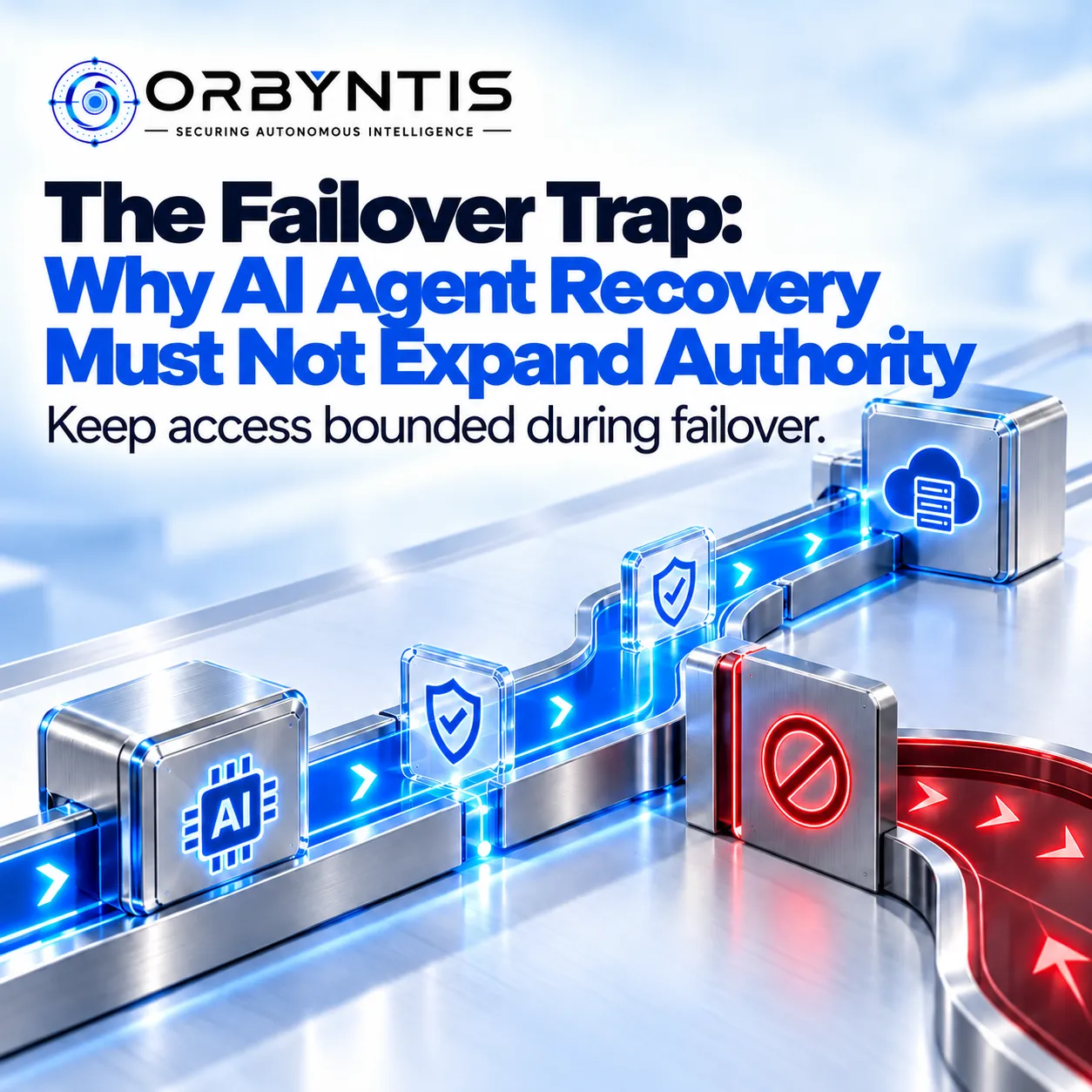
Failover is commonly tested as a question of availability: can the service continue when a model endpoint, region, or tool is unavailable? For an AI agent, that question is incomplete. Recovery may route execution through a different workload identity, tool implementation, data replica, network path, or policy service. The agent can remain operational while the authority behind its actions has changed.
The core failure mode is not that every backup is overprivileged. It is that equivalence is assumed from a successful health check. A backup endpoint that returns a valid response has demonstrated availability; it has not demonstrated equivalent authorization, data handling, or audit behavior.
Model failover as an authority transition
Represent the normal and recovery paths separately:
Primary: agent → identity A → tool set A → policy A → data region A
Recovery: agent → identity B → tool set B → policy B → data region B
For each path, compare the principal, trusted audiences, credential lifetime, allowed actions, resource scope, tenant boundary, tool schemas and implementation, approval enforcement, logging, and data residency constraints. Similar names and matching API shapes do not establish equivalent control. A recovery tool can accept the same request while applying a broader permission or omitting a validation step.
The comparison should include dependencies that may be hidden behind a gateway. A gateway could authenticate the agent with its normal identity but use a regional service credential to call the downstream system. The visible agent role is unchanged while the effective authority differs. Trace the request to the system that commits the action.
Build a threat model for degraded operation
Failover changes both the system’s failure state and the assumptions available to a defender. A policy endpoint may be unreachable; observability may be delayed; the recovery operator may use emergency credentials; and the alternate tool may return a different error contract. Attackers can exploit this pressure by inducing outages, exploiting incomplete health checks, or targeting the less-tested recovery path. A legitimate failure can also create risk without an attacker, when automation falls back to a path with broader defaults.
Threat-model the assets and trust boundaries that change: agent identity, model provider, tool adapter, secrets, policy service, data replica, approval channel, and audit pipeline. Ask what happens if each dependency is unavailable, compromised, stale, or only partially reachable. Identify which transitions are automatic and which require an operator. The highest-risk path is often not the backup itself but the unreviewed transition that activates it.
Health checks should establish the conditions needed for safe use, not merely that a process responds. A 200 OK endpoint can still be connected to the wrong tenant, stale dataset, or broad credential. Readiness should include identity, policy, and downstream dependency checks appropriate to the operation, while avoiding health probes that themselves grant meaningful authority.
Common recovery paths that alter scope
Model fallback. A secondary model may have different instruction-following behavior, context limits, safety features, or tool-calling behavior. Keep action authorization outside the model and preserve the same policy checks regardless of provider. If response parsing changes, reject ambiguous tool arguments rather than broadening defaults.
Tool or API fallback. A replica may expose a broader endpoint or accept different parameters. Compare capabilities and schemas, test authorization for each operation, and ensure dangerous actions do not become available just because the primary tool is down.
Regional recovery. A disaster-recovery role may be granted broad access to simplify restoration. AWS Well-Architected guidance describes emergency access patterns that rely on a separate identity with permissions to assume a role designed for recovery. This is an operational identity path that should be narrowly scoped, monitored, and tested—not inherited automatically by every agent workflow. AWS Well-Architected: Establish an emergency access process
Human or operator override. A manual “force resume” function may bypass a failed authorization service. Record who invoked it, which controls remain active, the allowed duration, and the actions permitted. Break-glass authority should be separate from routine automation and require a post-event review.
Compare primary and recovery capabilities explicitly
An equivalence review should compare capabilities, not just configuration files. For each operation, document whether the recovery path can read, create, update, delete, approve, or export the same classes of data; which tenant and region boundaries apply; and what independent approval is required. Where a capability is intentionally absent in recovery, verify that the application presents that limitation clearly instead of repeatedly retrying a prohibited action.
| Surface | Primary-path question | Recovery-path question |
|---|---|---|
| Identity | Which workload principal is authenticated? | Can the recovery principal assume broader roles or use a longer-lived credential? |
| Tools | Which operations are available? | Are schemas and implementation behavior equivalent and reviewed? |
| Policy | Which policy version authorizes the action? | Is the same policy available, current, and enforced? |
| Data | Which tenant, region, and classification are in scope? | Does replication or routing change those boundaries? |
| Approval | Which actions need a human decision? | Does the degraded path preserve that approval requirement? |
| Evidence | Which events are correlated and retained? | Are events buffered, delayed, or lost during recovery? |
Use explicit allowlists for the recovery mode. A deny-by-default posture is especially valuable when the fallback cannot reproduce every primary control. Avoid “temporary” wildcard permissions that remain after testing or become a permanent dependency.
Define invariants before testing recovery
Security properties should remain true across both normal and degraded operation. Examples include: no action outside the original tenant; no write operation when only a read path is available; no execution without current authorization; no broader data classification; no cross-region transfer prohibited by policy; and no missing audit correlation. Recovery can reduce capability or pause work. It should not silently increase it.
Where the backup cannot meet an invariant, encode a constrained mode. The agent might provide an analysis without executing a change, queue the request for later, or require a human to complete the final operation through a separately controlled channel. Clear degradation is preferable to a seamless but less governed path.
Make transitions observable and reversible
Every transition should emit a durable event containing the trigger, previous and new path, agent and workload identities, active policy version, tool or model versions, operator if applicable, and reason for the transition. Correlate later business actions to that event. If the backup is active for a prolonged period, alert an owner and require periodic review; otherwise a declared emergency path can quietly become the normal architecture.
Define how the system returns to primary operation. Recovery should not blindly replay queued writes, revive expired approvals, or preserve credentials that were created for an emergency. Reconcile the state of downstream systems first, then resume only operations whose authority and idempotency status are known. A controlled return-to-primary procedure is part of the recovery design, not an afterthought.
Reversibility also depends on the business action. Some actions cannot be undone even if the infrastructure route is restored. For payment, disclosure, deletion, or external communication, consider whether recovery mode should restrict the agent to preparation and require a separate final commit. The action’s irreversibility should influence the transition gate.
Red-team the transition, not just each endpoint
Test the state change itself. Trigger fallback during a read, before a write, after approval, during token refresh, and after the downstream system commits but before the agent receives a response. Attempt to reuse a primary-path token against a recovery endpoint; request an action absent from the approved tool set; alter tenant or resource identifiers; and simulate stale policy data in the recovery region.
Check that controls fail closed where required and that failures are visible. A failover test should capture which path was active, which identity and policy were evaluated, which tool version handled the request, and whether the resulting state was reconciled. If the primary returns after recovery, verify that traffic switches back without reviving stale sessions or duplicate operations.
OWASP’s agent security guidance recommends least privilege across agent tools and structured testing after material changes to tools, policies, model providers, and memory. Failover configuration changes several of these surfaces at once, so it belongs in the security regression set rather than only in availability exercises. OWASP AI Agent Security Cheat Sheet
A focused recovery test matrix
| Condition | Test action | Expected security result |
|---|---|---|
| Policy service unavailable | Trigger fallback during a write request | The operation is held or follows a documented constrained mode; no stale allow is silently reused |
| Alternate tool has a broader schema | Request an operation absent from the approved capability set | The client or downstream boundary rejects it and records the mismatch |
| Regional identity differs | Attempt cross-tenant access using recovery credentials | The resource boundary denies the request and records the effective principal |
| Approval expires during outage | Resume a previously approved queued action | Fresh approval or authorization is required when policy says the prior decision is no longer valid |
| Response lost after commit | Interrupt the connection after a downstream write | Reconciliation prevents an unverified duplicate action |
| Failback occurs | Restore primary service while work is queued | The system reconciles state and does not replay stale or unauthorized operations |
Run these tests in a representative environment with realistic identity mappings and downstream policy. A mock endpoint can validate orchestration logic, but it cannot establish that production IAM and resource policies enforce the intended boundary. Capture both the agent’s view and the system-of-record outcome.
Recovery should restore service within a declared boundary
Disaster recovery is not a temporary exception to authorization design. Document the recovery identity, equivalent and intentionally unavailable capabilities, approval path, logging requirements, and exit criteria. After a test or incident, compare the actual recovery path with the reviewed one and remove temporary permissions promptly.
The right success condition is not simply “the agent answered from another region.” It is that the system recovered the required business function while preserving its declared authority boundary—or stopped safely when it could not.
Recovery objectives should include control objectives
Recovery time and recovery point objectives describe service restoration and data loss tolerance. Agentic workflows also need a control objective: which authority must remain constrained during the recovery interval, and what evidence must survive? A recovery plan that restores an agent quickly but loses action attribution may create an unacceptable audit gap. A plan that retains clear boundaries but disables irreversible actions temporarily may be the correct business trade-off.
Review the plan with service owners, identity administrators, security operations, and business stakeholders. Record the capabilities intentionally unavailable during degraded mode and the criteria for restoring them. After exercises or incidents, remove emergency grants, compare actual and expected access, and update tests for any newly discovered path.