Abstract
Enterprise AI systems increasingly translate organizational rules into operational decisions. Yet a written policy rarely contains every fact needed to determine whether a particular action is appropriate. This article presents a practical distinction between the policy that constrains a decision, the business context that gives the decision meaning, and the exception path that governs cases where the first two do not resolve the situation. A hypothetical invoice workflow illustrates the distinction. The resulting model treats exceptions as designed outcomes, not as failures to be handled after deployment, and identifies the evidence and tests needed to keep decision authority reviewable over time.
Keywords: AI governance, decision systems, business context, exception handling, enterprise AI
A rule can be followed and still be insufficient
Imagine an invoice-processing agent operating under a clear rule: invoices that match an approved purchase order and fall below a defined amount may be processed automatically. The rule is specific, auditable, and easy to test.
Now add one fact. The supplier changed its payment details yesterday, and the organization has not yet verified that change. The invoice can still match the purchase order and remain below the threshold. A literal check may pass even though the surrounding business situation has changed in a way that calls for another decision.
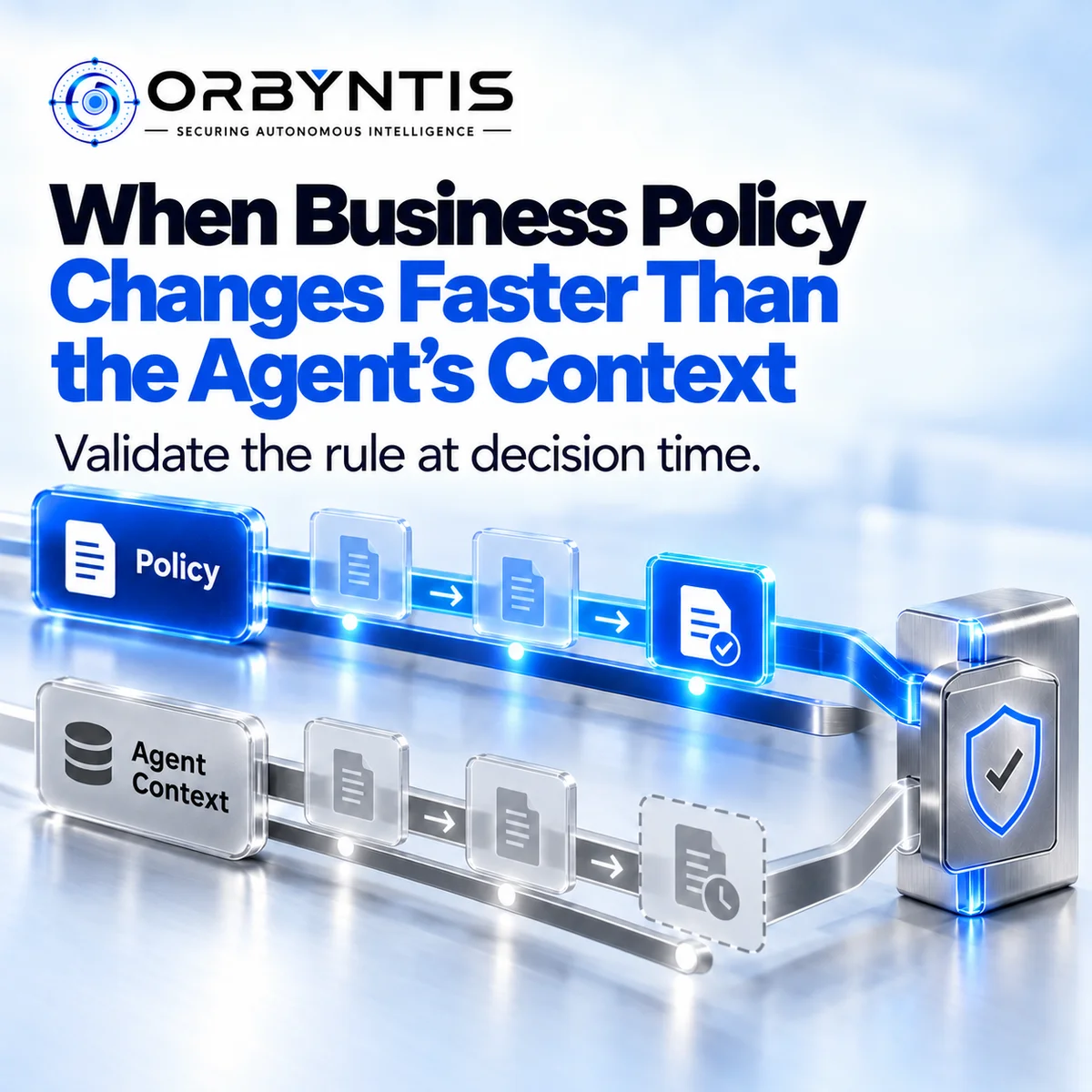
This hypothetical example is not a defect in the wording of the threshold. It illustrates a design limit: policy describes conditions for action, while context determines whether those conditions adequately describe the case in front of the system. When the two do not align, an organization needs an explicit route for resolving the difference.
The distinction matters because an AI system does not act on a policy document in the abstract. It acts on a representation of the policy, a set of available facts, and a workflow that determines what happens when those facts are incomplete or conflicting.
Three parts of an operational decision
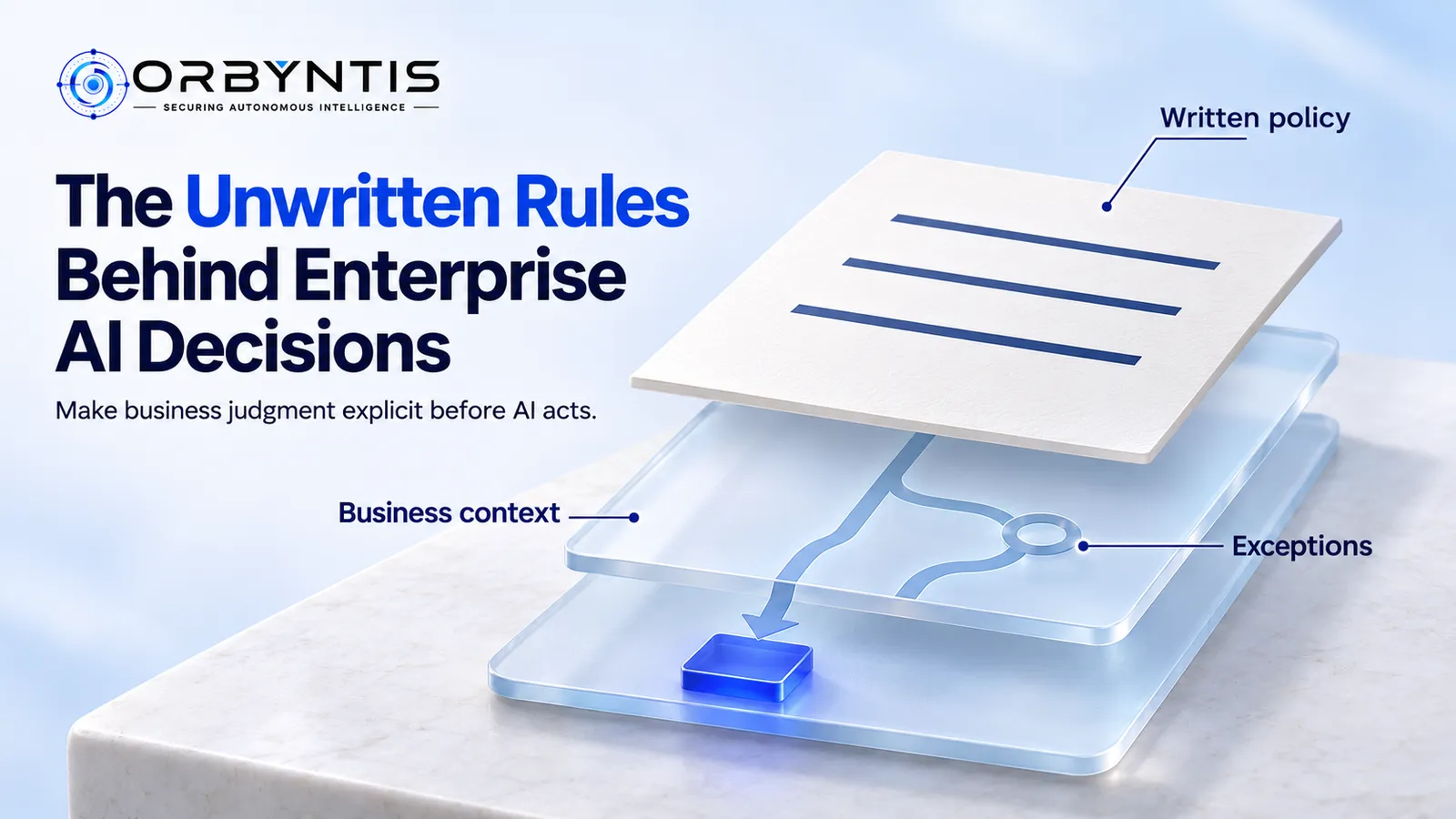
The following model is a proposed design aid, not a formal standard. It separates three questions that are often collapsed into a single instruction such as “follow the policy.”
| Layer | Question it answers | Example in the invoice workflow |
|---|---|---|
| Policy | What conditions and limits apply? | A matched invoice below the defined amount may proceed. |
| Context | What is true about this case now? | The supplier’s payment details recently changed and remain unverified. |
| Exception path | What should happen when the conditions do not settle the case? | Hold payment and route the change for an authorized review. |
The policy supplies a boundary. Context supplies case-specific facts. The exception path assigns a safe next step when those facts make the ordinary route uncertain. None of the three can reliably substitute for the others.
Context is part of the decision specification
In conventional software, a rule may be evaluated against a compact set of fields. AI-enabled workflows can draw on documents, messages, system records, tool responses, and human input. Those sources may disagree, arrive at different times, or describe different versions of the business situation.
For that reason, “the agent had the policy” is not enough to explain an outcome. A reviewable decision also needs a defined account of which contextual facts were relevant, where they came from, when they were considered, and whether they were current enough for the action at hand.
This is consistent with the socio-technical framing in NIST’s AI Risk Management Framework: risk can arise from the interaction of technical design with how a system is used, who operates it, and the setting in which it is deployed. NIST’s companion playbook also recommends defining the business value and context of use as part of AI risk management. These are useful design references; they do not prescribe one universal decision architecture. (NIST AI RMF, Executive Summary; NIST AI RMF Playbook, Map 1.4)
The practical implication is modest but important: context should be specified as an input to the workflow, not left as an unstated assumption in a prompt or an operator’s memory. A policy that depends on supplier verification, for example, should identify the authoritative source for that status and the acceptable age of the record.
Treat exceptions as designed outcomes
An exception is not necessarily an error. It may be the correct result when the system encounters a material change, missing evidence, conflicting records, stale data, or an action whose consequences exceed the assumptions behind the ordinary rule.
Organizations can make this behavior concrete by defining a small set of outcomes for the workflow:
- Proceed when the policy conditions are met and the required context is present and current.
- Pause for review when a material fact is missing, disputed, or outside the approved conditions.
- Stop and escalate when the action is prohibited or the available evidence indicates an unacceptable risk.
These outcomes are illustrative. Their names, owners, and thresholds should reflect the actual business process. The essential requirement is that uncertainty has an operational destination. “Ask a human” is not a complete exception path unless the reviewer receives relevant evidence, has authority to decide, and can prevent the action from proceeding in the meantime.
Nor should a model’s explanation serve as the enforcement mechanism. A model may help identify a possible exception or summarize the evidence for a reviewer. The surrounding workflow should enforce whether an action is permitted, paused, or blocked, and record the rule and context that produced that outcome.
Preserve the basis for the outcome
A decision record need not preserve every conversation or duplicate every source system. It should retain enough information to reconstruct why the workflow proceeded, paused, or stopped. Depending on the process, that may include:
- the policy or rule version applied;
- the specific conditions evaluated;
- the source and timestamp of material contextual facts;
- any exception raised and the reason it changed the route;
- the resulting action or hold, including the responsible reviewer where applicable.
This record makes it possible to distinguish a policy defect from stale data, an integration error, or a workflow that failed to enforce its own boundary. It also gives the business owner a basis for reviewing whether the defined context still matches the real process.
Evidence collection should remain proportionate. Retain what is needed for operational review and applicable recordkeeping, subject to the organization’s privacy, access, and retention requirements. More data is not automatically better evidence.
Test the boundary, not only the ordinary case
An acceptance test that checks whether a valid invoice proceeds tells only part of the story. Decision behavior should also be tested when relevant facts change one at a time: supplier details are newly updated, verification is unavailable, two records conflict, or the policy version changes while a case is in progress.
These tests examine whether the system distinguishes “condition satisfied” from “enough is known to act.” They should include the expected result for each exception and confirm that a pause cannot be bypassed by retrying the same action through another route. Where people review cases, test whether they can see the evidence that triggered the exception and whether their decision is recorded.
The test set should evolve with the workflow. New tools, data sources, approval steps, and business practices can change which contextual facts matter. NIST’s AI RMF recommends ongoing measurement and management across the system lifecycle; its playbook includes evaluation in conditions similar to the intended deployment context. That supports a lifecycle approach to these tests rather than a one-time pre-release check. (NIST AI RMF 1.0; NIST AI RMF Playbook, Manage)
A more precise question for governance
When an AI-enabled workflow produces an outcome, asking only whether it followed a written rule leaves a gap. A stronger review asks three questions: Was the applicable policy represented correctly? Did the system have the context needed to determine whether that policy applied? When the answer was uncertain, did the exception path place the decision with an owner who could resolve it?
That framing does not require every decision to be made by a person. It requires organizations to be explicit about which decisions can proceed under defined conditions, what evidence those conditions depend on, and who or what takes responsibility when the conditions no longer hold.
Written policy remains essential. Its operational meaning, however, depends on context and on a credible route for exceptions. Designing those elements together is what makes an AI-mediated decision understandable before it is challenged and reviewable after it has been made.
References
- National Institute of Standards and Technology. Artificial Intelligence Risk Management Framework (AI RMF 1.0). 2023. https://nvlpubs.nist.gov/nistpubs/ai/NIST.AI.100-1.pdf
- NIST AI Risk Management Framework Playbook. “Map 1.4: The business value or context of business use has been clearly defined.” https://airc.nist.gov/airmf-resources/playbook/map/
- NIST AI Risk Management Framework Playbook. “Manage.” https://airc.nist.gov/airmf-resources/playbook/manage/