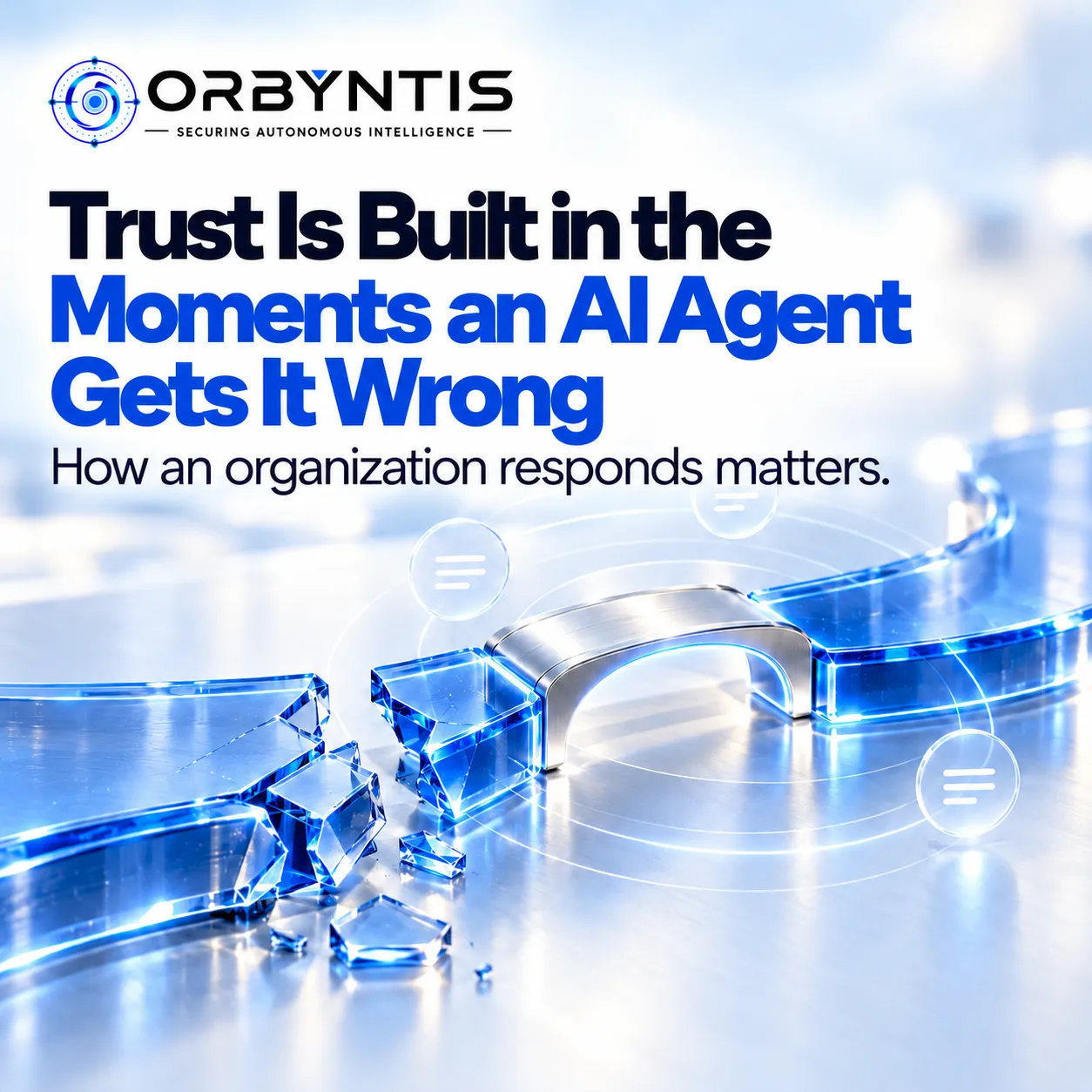
Trust in an AI system is easy to discuss when the workflow is behaving as expected. The more revealing moment comes when an agent misunderstands a request, acts on incomplete information, or produces an outcome that surprises the people responsible for it.
An error does not automatically mean a system is untrustworthy. In complex work, mistakes can occur in software, process, data, and human judgment. What matters is whether people can recognize what happened, understand who is responsible for the next decision, correct the outcome, and learn without hiding the failure. Trust is shaped by the organization’s response as much as by the agent’s performance.
The first response is a governance decision
Imagine a hypothetical internal service agent that routes a request to the wrong team. The immediate temptation may be to describe the issue as a model hallucination and move on. But that label does not tell the affected person whether their request was seen, whether sensitive information went to an unintended recipient, or when the service will be corrected.
A responsible response begins with plain acknowledgment: what is known, what remains under review, what action has been paused, and who is accountable for follow-up. The organization should avoid claiming a root cause before evidence supports it. It should also avoid asking the person affected to diagnose the system that failed them.
Communication is not a substitute for technical investigation. It is part of safe operations because users need a way to report an unexpected result and a clear expectation about what happens next.
A hypothetical incident, from surprise to repair
Consider a hypothetical employee-support agent that routes a request using information retrieved from an outdated internal page. The request reaches a team that should not have received it. The agent has not necessarily “decided” to disclose information in a human sense; the organization still has to address the effect. It can pause the affected routing path, confirm what information moved and who could see it, contact the affected person through an appropriate channel, and preserve evidence for a careful review.
The immediate communication should separate known facts from open questions. “The request was routed to the wrong queue” may be established; “no one viewed it” may not be. Clear language prevents reassurance from outrunning evidence. It also gives the affected person a way to ask for correction or provide missing context.
The investigation then follows the workflow: source page freshness, retrieval behavior, routing policy, permissions on the destination queue, and monitoring. The correction may be technical, procedural, or both. This scenario is hypothetical and illustrates a response pattern; it is not a claim about an Orbyntis customer or deployment.
Make correction possible for the people affected
The ability to challenge an agent outcome should match the consequence of the workflow. For a low-impact routing error, a visible correction option and a timely human response may be sufficient. For decisions that affect access, employment, financial entitlements, health, or other significant interests, organizations need stronger review paths, clear ownership, and appropriate human decision authority.
Correction should address the underlying record as well as the visible answer. If an agent changed a system of record, the organization should identify whether the change can be reversed, whether downstream teams or systems acted on it, and whether those effects need correction too. A polished apology without a path to repair leaves the original burden with the person affected.
Design reporting channels people will actually use
People need to know how to report an unexpected agent action without first understanding whether the issue is a model defect, a data problem, or a workflow bug. Provide a visible route from the interaction itself, a named operational owner, and a way to submit relevant context without asking the user to expose more sensitive information than necessary.
The reporting process should acknowledge receipt, set an expected response time, and explain whether the system or a specific capability has been paused. If the issue is not reproducible, say what evidence was reviewed and what uncertainty remains. A silent ticket closure teaches users that the organization values system uptime more than their experience.
Accessibility matters here. The route should work for people using assistive technology, support the languages and channels relevant to the workforce, and avoid requiring access to an internal engineering tool. A governance process that exists only for technical insiders is unlikely to reveal the failures experienced by everyone else.
Accountability needs named roles
“The AI made the decision” is not an accountable explanation. Before deployment, organizations should identify who owns the business process, who maintains the agent and its integrations, who can suspend an action path, and who handles reports from affected users. These responsibilities can be shared, but they should not be ambiguous at the moment of an incident.
The agent’s role should also be described honestly. If it recommends and a human decides, say so and ensure the human has enough information and authority to exercise judgment. If it can execute an action within a policy boundary, explain the boundary and the route for review. Calling a workflow “human supervised” is not meaningful if the human cannot see, question, or stop what is happening.
Keep human oversight substantive
Human review can become ceremonial when reviewers face a high volume of low-context decisions, cannot see the evidence, or are rewarded only for speed. A meaningful review gives the person the relevant source material, the proposed action, the applicable rule, and a clear opportunity to pause or reject. It also makes clear whether the human is accountable for the final decision or is only monitoring system operation.
The amount of oversight should reflect consequence and reversibility. Low-impact, reversible routing may be automated with sampling and correction. An irreversible or rights-affecting decision may need a qualified reviewer with authority to change the result. The design should consider workload and escalation capacity, not assume that inserting a human button makes the process safe.
Where users are affected by a decision, provide an understandable route to challenge it. The review should be performed by someone who can consider relevant context and is not simply asked to ratify the original model output. This is a governance design choice that should be made before deployment, not improvised after an incident.
Learn from errors without turning people into test cases
Every reported issue can improve the system, but learning requires care. Teams should preserve the relevant event evidence, investigate the full workflow, and distinguish a one-off failure from a repeatable control weakness. They should consider the input data, context, tool behavior, policy, interface, and organizational process—not just model output.
People who report problems should be treated as contributors to safety, not as obstacles to automation. A clear reporting channel, a non-punitive route for good-faith concerns, and feedback about what changed can encourage early reporting. Where an incident involves personal or sensitive information, investigate and communicate under the organization’s privacy and incident-response obligations.
NIST’s AI Risk Management Framework treats trustworthiness as a socio-technical concern and connects governance with mapping, measurement, and management throughout the system lifecycle. This supports a practical discipline: define how the organization will detect, respond to, and learn from errors before the first high-impact failure occurs. NIST AI Risk Management Framework
Turn reports into system learning
An incident review should ask more than whether the model’s answer was correct. Examine the full chain: the task presented, the data available, the agent’s configured authority, the interface shown to the user, the policy and tool behavior, the human review, and the downstream effect. Determine whether the error was foreseeable, whether an existing control should have stopped it, and whether the reporting route worked.
Separate corrective action from blame. A frontline employee may have relied on an interface that omitted uncertainty; an operator may have followed an approved procedure that lacked a needed check. A learning-oriented review looks for conditions that made the outcome likely and assigns practical changes to owners. This does not remove accountability; it makes accountability specific enough to improve the system.
Close the loop with the person who raised the issue when appropriate. Explain what was changed or why no change was made, while protecting confidential investigation details. Aggregate themes can inform evaluation sets, workflow redesign, training, and governance reviews. Ensure that incident data is handled under privacy and retention rules and is not reused for model training by default.
Trust grows through visible repair
People do not need an organization to claim that an agent will never be wrong. They need evidence that the organization knows what the agent is allowed to do, can detect when its behavior is unexpected, and will take responsibility when the outcome affects someone.
That evidence is built in ordinary moments: a concern is received without dismissal; a decision can be reviewed; an incorrect record is corrected; the relevant control is improved; and the people who rely on the system learn what changed. Those practices make trust operational rather than aspirational.
Look for signals beyond satisfaction scores
Trust cannot be reduced to a single survey measure. Useful signals include whether people know how to challenge an outcome, whether reports receive timely acknowledgment, whether recurring failure modes decline, whether corrections reach downstream systems, and whether teams can explain what authority an agent has. A high satisfaction score may coexist with low awareness of recourse; a rise in reports may reflect that people have found a channel and feel safe using it.
Interpret measures in context and combine quantitative indicators with interviews and case review. Avoid treating low complaint volume as proof of safety. Users may not recognize an error, may not know where to report it, or may believe that raising a concern will have no effect. Monitoring should examine barriers to reporting as well as system outcomes.
Make trust a practice, not a promise
Organizations do not earn confidence by claiming that an agent is reliable in every circumstance. They earn it by setting understandable boundaries, assigning responsibility, making review accessible, correcting affected outcomes, and learning openly within appropriate privacy constraints. Those commitments should be visible in normal operation and credible under pressure.
When an agent gets something wrong, the moment becomes a test of the institution around it. A careful response cannot erase the error, but it can reduce further harm and demonstrate that the organization treats people as participants in safe AI use rather than as passive recipients of automated decisions.