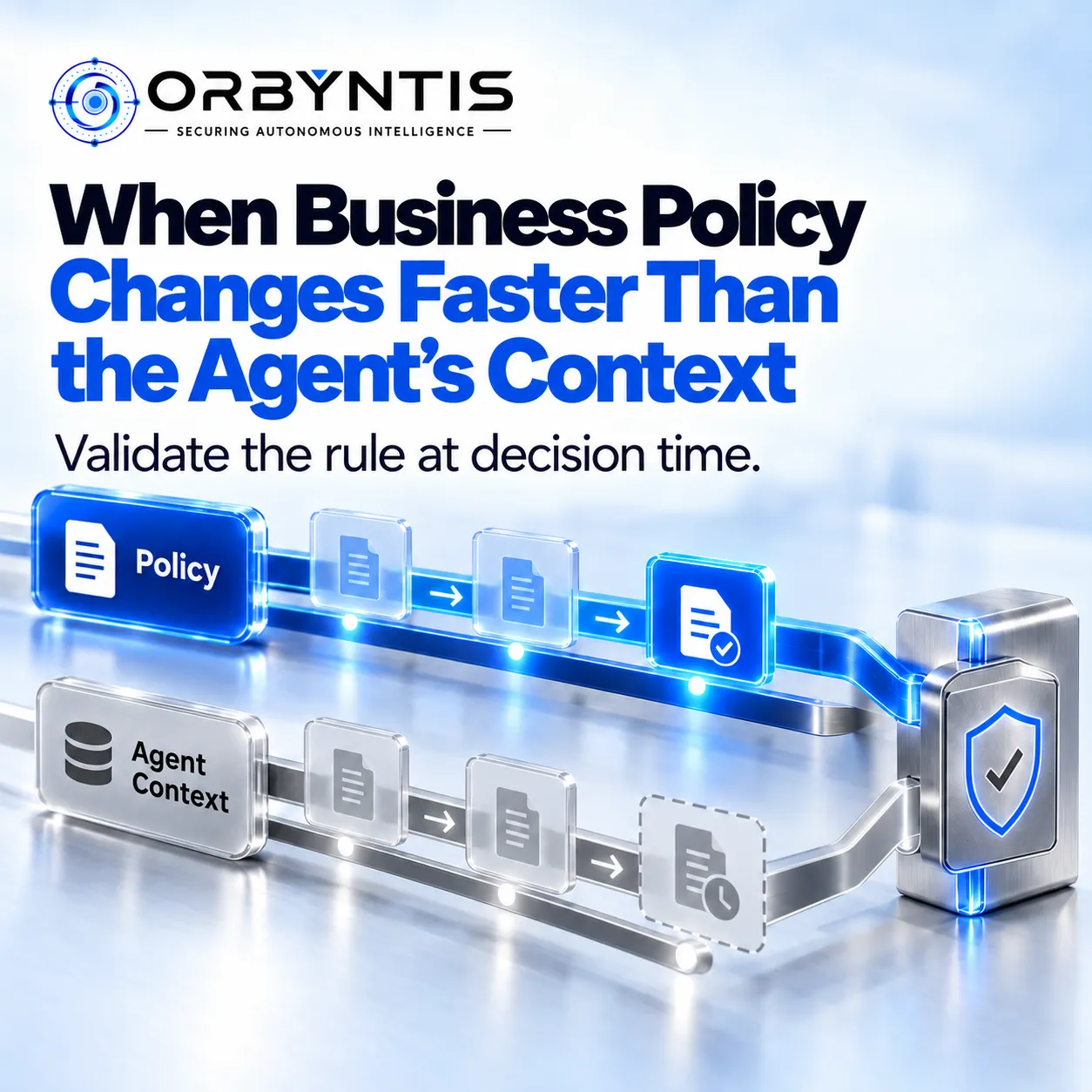
At 09:00, a finance policy permits an agent to approve routine expenses up to a defined threshold. At 11:30, the organization changes the threshold after a control review. At 11:45, a long-running agent session evaluates a claim using a policy excerpt retrieved before the change. The document is still present in the conversation context, and the workflow still has an approval token minted under the former rule.
This is a temporal consistency problem. Updating the authoritative policy does not guarantee that every copy, cache, session, or in-flight decision now reflects it. For autonomous workflows, policy freshness must be enforced where a decision becomes an action.
Context can outlive the rule it describes
Policy information can reach an agent through system instructions, retrieval results, tool responses, workflow variables, caches, or a human approval issued earlier. Each copy has a different lifetime. A session may persist across several tasks; a retrieval cache may be refreshed on a schedule; an approval may remain valid until expiry; a tool may use a server-side ruleset that updates independently of the agent.
The model cannot reliably infer that a familiar statement is obsolete. Nor should a natural-language instruction be treated as the authoritative policy boundary. It can guide behavior, but a sensitive action should be checked against a current, authoritative policy service or equivalent control at the point of execution.
Freshness is a property of state, not just documents
Teams often focus on refreshing a knowledge base, but policy-dependent state exists in more places than retrieved documents. A tool may cache a decision; a workflow may retain an approval; a session may carry a prior tenant or risk classification; a queue may preserve a prepared request; and a model endpoint may serve an earlier agent configuration. The right unit of analysis is the state that can affect the next action.
For each state element, identify its source of truth, version, cache lifetime, invalidation mechanism, and the consequence if it is stale. A few minutes of delay may be acceptable for a low-impact informational response. A write action involving money, access, or regulated data may need a fresh check immediately before execution. This is a risk-based consistency requirement, not a demand that every component synchronously reload every policy on every turn.
Choose a consistency model deliberately
Three broad patterns are useful. Short-lived cache with revalidation allows routine reads to reuse a policy snapshot while requiring current validation at a sensitive action boundary. Push invalidation distributes change events quickly, but consumers must handle missed events and reconnects. Version-bound decisions attach a specific policy version to an approval or operation and reject execution if that version is no longer valid.
Many systems combine these patterns. For example, a runtime can cache explanatory policy content for a session, receive invalidation events when policy changes, and still call an authorization service before a write. The important design property is that the write boundary does not infer permission from stale conversational context.
Choose the model based on impact, throughput, availability needs, and the policy’s actual change rate. Document the maximum tolerated staleness and how the system behaves when the policy service is unavailable. An undefined fallback is still a fallback; it may simply be the last cached decision.
Separate policy communication from policy enforcement
There are two useful planes. The context plane helps the agent understand the policy and produce a relevant proposal. The enforcement plane decides whether a specific actor may perform a specific action on a specific resource under the current rule. The context plane can be cached for efficiency; the enforcement decision needs explicit freshness semantics.
For an action request, bind the evaluation to the facts that matter: policy identifier and version, effective time, subject and delegated identity, requested operation, resource, relevant attributes, and any approval reference. The enforcement service can reject a stale policy version, require reevaluation, or return a decision with a bounded validity period. The caller should not be allowed to supply a self-asserted “current policy” version as evidence.
This pattern is consistent with a broader security principle: authorization is evaluated at the protected boundary, using trusted attributes and current policy. A precomputed decision may be reused only if its scope, validity period, and revocation behavior are explicit. If a rule change must take effect immediately, cached authorization and long-lived approval artifacts need a revocation or invalidation path.
An action-time decision contract
A useful authorization request carries enough trusted information to evaluate the real action: authenticated subject and delegated agent identity, operation, resource, tenant, relevant business attributes, approval reference, policy version if pinned, and the operation’s stable identifier. The policy service should return a decision, a reason code suitable for operations, the policy version evaluated, and any expiry or obligations.
The caller should bind the returned decision to the exact request. If the amount, destination, record, or action changes after evaluation, the workflow should ask again. This prevents a valid decision for one set of parameters from being reused for another. For multi-step workflows, define whether each action gets a separate decision or whether a bounded authorization covers a well-defined sequence.
Avoid passing sensitive policy logic into the prompt as the only control. Prompts can be versioned and reviewed, but the model can still misinterpret instructions or receive conflicting context. Conversely, a policy service that evaluates incomplete or model-supplied attributes can produce a formally valid but incorrect result. Validate critical attributes from the authoritative business system.
Treat a policy change as an invalidation event
When a material rule changes, identify the state that may depend on the old version:
- Update the authoritative policy and assign a version or effective timestamp.
- Publish an invalidation signal to relevant agent runtimes and caches.
- Expire or reevaluate pending approvals and queued operations within the affected scope.
- Require a fresh authorization decision before execution of sensitive actions.
- Record which version was evaluated and why the operation was allowed, denied, or held.
Signals improve propagation speed but are not a complete guarantee. A disconnected runtime may miss an event; a queue can deliver late; a long-lived session can continue after an invalidation. Use a bounded cache lifetime and a server-side check at action time for high-impact operations. For low-risk actions, a risk-based freshness window may be acceptable if the organization documents the delay it is willing to tolerate.
Versioning also needs semantic discipline. A changed document timestamp is not always a meaningful policy change, and a unchanged version label does not prove the rule remained stable. Maintain immutable policy versions, a controlled effective date, and a human-readable change record that identifies affected workflows and decisions.
Bind approvals to the facts they approved
An approval for one operation should not become a general permission to act under a future policy. Bind approval to the request parameters that matter: amount, destination, tenant, data class, workflow, and expiry. If any relevant fact or policy version changes, the workflow should determine whether to invalidate, renew, or re-evaluate that approval.
This is particularly important for queued work. A task can be proposed and approved under one policy, then sit in a queue while requirements change. Before the side effect, verify that the approval remains valid and the current policy still permits the action. If the system cannot establish freshness, holding the operation for review is safer than silently treating old context as current authority.
Handle in-flight work and degraded operation
Policy changes create boundary cases. A request may be approved before the new rule takes effect but execute afterward. Another may be submitted before the change and remain unresolved due to a timeout. The policy owner must specify whether the effective time governs proposal, approval, or execution, and how pending work is treated. This is a business rule with technical consequences; teams should not let queue timing decide it accidentally.
If the policy service is unavailable, choose an explicit outcome by action class. A workflow can continue with a cached decision only when the cache validity and permitted action are defined. For a high-impact operation, hold or deny may be appropriate. For an informational response, a degraded mode may be acceptable if the output clearly indicates its freshness. Avoid a universal “fail open” or “fail closed” claim without describing which operations it covers.
Record stale-state decisions as first-class outcomes: revalidated, invalidated, held_for_review, or allowed_under_documented_degraded_mode. This allows operations teams to see whether changes propagate as designed and gives reviewers evidence that a stale state was recognized rather than overlooked.
Exercise stale-state behavior
Test policy updates during an active session, after retrieval but before tool invocation, while an approval is pending, and after a request enters a queue. Include missed invalidation events and unavailable policy services. Expected behavior should be explicit: deny, hold, or use a documented fallback with constrained authority. “Continue with the last known rule” is itself a policy choice and should require an owner, scope, and time limit.
Measure propagation delay from policy publication to enforcement across all execution paths. Also verify that records can answer which policy version informed the agent’s proposal and which version authorized the action. These may differ; preserving both is often essential to explain the outcome.
Test policy drift with timing, not just versions
Version tests should cover the intervals between retrieval, decision, approval, queueing, and execution. Change a policy after the agent retrieves it; change it after human approval but before submission; deliver invalidation while a session is disconnected; delay a queue item past the policy’s effective time; and make the policy service unavailable during recovery. Verify the exact expected disposition in each case.
Tests should include semantically equivalent edits as well as material ones. A formatting change may create a new document version without changing permissions; a changed threshold may be a one-line edit with major impact. Review systems need a way to classify policy changes by meaning and scope, with an accountable owner for materiality. Automatic diffing can identify candidate changes, but it does not decide their business consequences by itself.
Measure end-to-end propagation delay and the proportion of sensitive actions that are evaluated at the intended boundary. Include sessions that remain open for hours, tool processes that cache configuration, and asynchronous callbacks. A test that restarts every component after the policy update can miss the stale state that exists in normal operations.
Fresh context is useful; current authority is decisive
Refreshing prompts and retrieval sources reduces stale information, but it does not create a reliable authorization boundary. Keep policy explanation close to the agent, and keep current permission checks at the system that can commit the business effect. A policy change should invalidate dependent decisions according to risk, and the resulting behavior should be observable and reviewable.