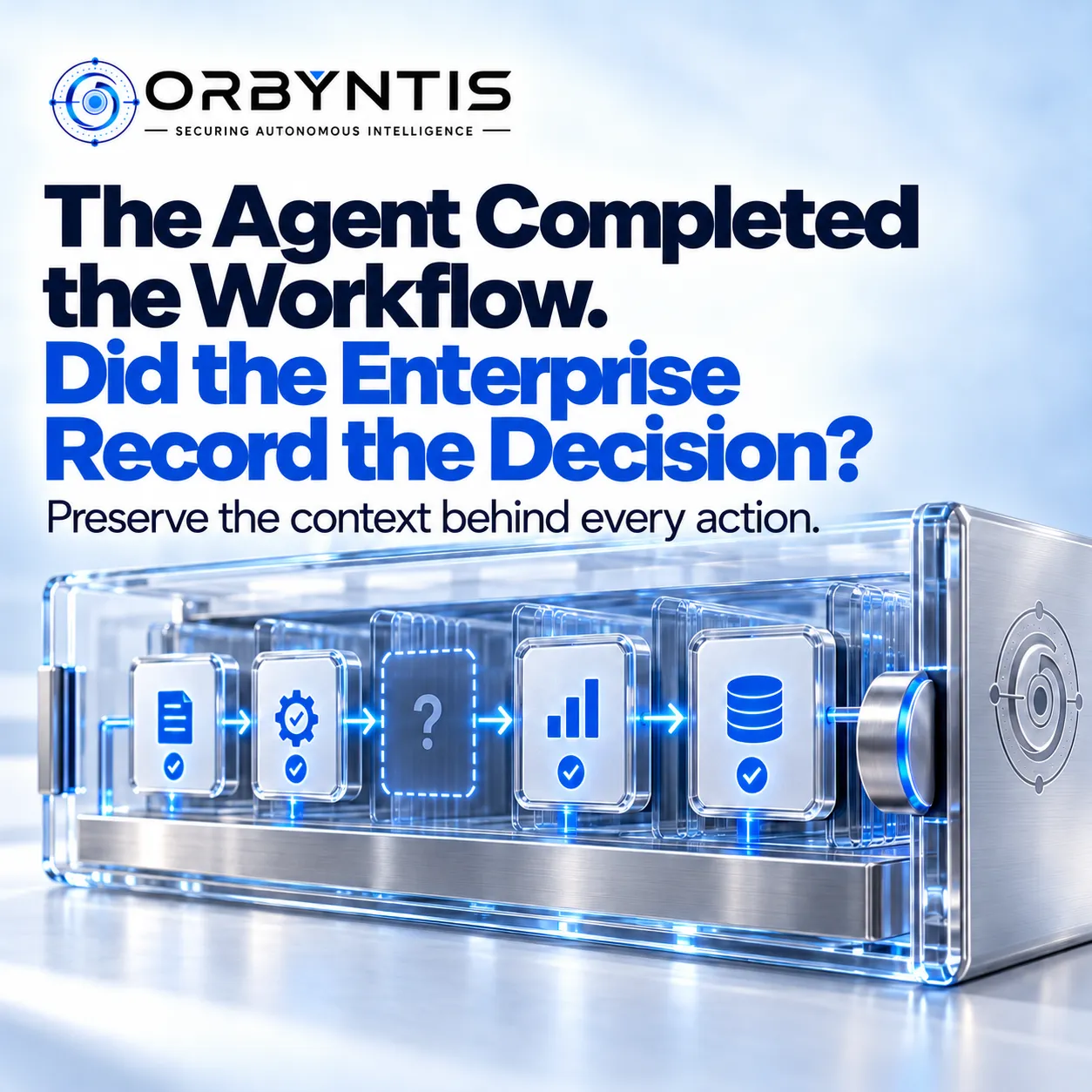
An agent closes a supplier case. The workflow platform records a successful run, the tool reports 200 OK, and the case-management system shows a changed status. Months later, an auditor asks a different question: why was the case closed, which evidence did the agent rely on, what policy applied, and who had authority to permit the action?
A completion event cannot answer those questions by itself. It establishes that a workflow reached an end state. Decision traceability requires a record of the relevant context and control path, connected to the resulting business action in a way that can be verified later.
A decision is a chain of claims
The record for an agent-assisted action should let a reviewer reconstruct a bounded chain:
Request → applicable policy → evidence considered → agent proposal
        → authorization / approval → tool action → business outcome
Each link answers a different question. The request identifies the intended work and its requester. The policy identifies the rules effective at decision time. The evidence records which sources or business records informed the proposal. The proposal captures what the agent recommended or selected. Authorization and approval show which control permitted the action. The tool event and downstream result establish what actually happened.
Not every workflow needs a transcript of every token or intermediate model thought. In many cases, retaining hidden reasoning is neither necessary nor an appropriate way to explain a decision. The useful record is a structured account of inputs, source references, policy versions, material outputs, control decisions, and effects—sufficient for the organization’s review purpose without collecting irrelevant or sensitive data.
Start by classifying the decision and its consequence
Record design should begin with the business decision, not with the logging features offered by an agent framework. A recommendation to summarize an internal document has a different consequence from a workflow that changes a customer record, releases funds, or denies access. The consequence determines the evidence needed, who can review it, how quickly it must be available, and how long it should be retained.
For each workflow, identify whether the agent proposes, prepares, or executes an action; whether a human review is required; and which downstream system is authoritative for the final result. Also document foreseeable failure outcomes. A timeout after submission is not the same state as a denied request, even if both appear as an error in the agent interface.
This classification helps avoid two extremes: recording too little to reconstruct a consequential event, or collecting every prompt and response indefinitely. Define the evidence objective first, then collect the minimum data that can meet it.
Define the record around the action boundary
For a consequential action, a practical event schema can include:
| Field | Purpose |
|---|---|
| Event and operation identifiers | Correlate retries and downstream effects without confusing separate attempts |
| Requester, agent, and delegated principal | Establish who initiated the work and under which identity it ran |
| Workflow, model, tool, and policy versions | Identify the configured decision environment |
| Evidence references and timestamps | Show which source records were available and when |
| Decision or proposed action | State the business-relevant result, with a reason code where appropriate |
| Authorization and approval result | Record the policy evaluation, approver, scope, and any conditions |
| Downstream request and response identifiers | Link the agent event to the system of record |
| Final state and correction history | Distinguish attempted, completed, reversed, and amended actions |
These fields are a design starting point, not a universal compliance schema. Data minimization, privacy, retention obligations, and domain requirements determine what should be stored. A record should point to protected source evidence when reproducing the source would create unnecessary exposure. It should also identify when evidence is no longer available, rather than silently presenting a partial reconstruction as complete.
Connect events into a durable operation record
A practical architecture separates the business operation from its individual events. The operation record carries a stable identifier and current state; events describe transitions such as proposal created, policy evaluated, approval recorded, request submitted, response received, and outcome reconciled. Each event has its own identifier and timestamp, while references link it to the operation and relevant downstream objects.
This design makes retries and asynchronous actions easier to interpret. Suppose a payment request is submitted, the network response is lost, and a worker retries. The record should show one business intent, two attempts, and the downstream transaction identifier if the first attempt committed. Without a stable operation ID, reviewers may mistake the retry for a second authorized decision—or miss a duplicate effect entirely.
Use an event schema with explicit status semantics. submitted, accepted, completed, unknown, rejected, and reversed should not be collapsed into a generic success boolean. Unknown is a real operational state that calls for reconciliation. It should remain visible until the system of record resolves the outcome.
Preserve integrity and meaning
Auditability depends on the reliability of the record. Use access controls that separate event producers from record administrators, timestamps from a trusted time source, append-only or tamper-evident storage appropriate to the risk, and monitored access to the evidence. Cryptographic hashes can help detect changes to a retained artifact, but a hash alone does not establish that the original content was accurate, authorized, or captured at the right point in the workflow.
Correlation identifiers matter as much as storage. A single business operation may produce several model calls, tool attempts, retries, and callbacks. Give the operation a stable identifier and each attempt a distinct identifier. This allows reviewers to distinguish an agent proposal from an executed action and an original attempt from its recovery path. For actions with side effects, record the downstream system’s transaction or object ID rather than relying solely on agent-side logs.
Versioning is essential. A record that says “policy passed” is weak if it cannot identify the policy version or the attributes evaluated. Likewise, a workflow name is not enough when prompts, tools, retrieval sources, or agent configuration can change. Pin or otherwise resolve references to immutable versions where the platform supports them, and log the resolved version actually used.
Protect evidence without making it unusable
Decision records can contain personal data, commercial details, confidential source material, or security-sensitive prompts. Apply access controls by role and purpose, encrypt evidence in transit and at rest, and define retention and deletion rules before deployment. Separate operational observability from formal evidence where their audiences and retention needs differ. A broad debugging log should not automatically become a permanent audit repository.
When source material is stored elsewhere, record a stable reference and the version or timestamp needed to retrieve the relevant state. A mutable URL is not sufficient if the content can later change. Depending on risk, preserve an approved snapshot, a content digest, or a version ID. The record must be clear about what a digest can establish: it can help detect whether a candidate artifact matches, but does not prove who created it or that it was the evidence actually shown to the agent unless capture and custody are controlled.
Make records understandable to their intended reviewers. Machine-readable fields support correlation and analytics; concise human-readable summaries help an auditor or process owner assess what happened. The summary should be generated from recorded facts, identify uncertainty, and avoid presenting an agent-generated rationale as an independently verified explanation.
Distinguish explanation, evidence, and justification
These terms are related but not interchangeable. An explanation communicates how the workflow reached an outcome in language suited to a reviewer. Evidence is the preserved information supporting claims about inputs, policy, identity, approvals, and effects. Justification explains why the organization considers the action acceptable under its rules and responsibilities.
An agent’s natural-language response may contribute to an explanation, but it is not a substitute for evidence. A fluent statement that “the request met policy” does not show which rule ran or what attributes it evaluated. Conversely, raw logs can be authentic and still fail to explain the business meaning of a field or why a human approved the action. A credible record connects the two: authoritative event facts with a careful, reviewable summary.
Where a workflow uses model confidence or a generated rationale, capture it only when it serves a defined review purpose. Do not treat confidence as a calibrated probability unless the system has been evaluated for that interpretation. Do not imply that a model’s internal reasoning trace is complete, stable, or a faithful causal account of its output.
Reconstruct a decision without overstating certainty
Consider a hypothetical expense workflow. An agent classifies a claim, retrieves the applicable policy section, and proposes reimbursement. The approval service evaluates claimant, amount, cost center, policy version, and delegation scope. The payment system then returns a transaction reference. A meaningful record links those events and distinguishes the model’s recommendation from the policy engine’s authorization and the payment system’s execution.
That distinction is important when something goes wrong. If a claim was paid under an outdated policy, the organization needs to determine whether the policy service returned an old version, the workflow used a stale cache, the approval boundary failed to re-check, or the downstream system accepted an unauthorized request. A generic “agent completed successfully” event obscures these failure modes.
NIST’s guidance on explaining AI-assisted decisions emphasizes documenting the stages that contribute to a decision and making documentation understandable to audiences with different levels of technical knowledge. The practical implication is that a technical event trail should support a concise operational explanation, not require every reviewer to infer meaning from raw traces. NIST: Explaining decisions made with AI
Test the evidence path as part of the workflow
Before production, test whether a reviewer can reconstruct representative outcomes: an allowed action, a denied action, a human override, a timeout with unknown downstream state, a retry, and a later correction. Verify that records are emitted when components fail, not only on the happy path. Confirm that event producers cannot rewrite prior decisions and that an authorized reviewer can retrieve the linked evidence within the operational timeframe.
Also test the limits of the record. If a source document is updated or deleted, can the event still identify the version originally consulted? If an external tool returns untrusted content, is that fact represented? If a record contains personal or confidential data, do its access and retention controls match the source system’s obligations? Strong traceability makes these limitations explicit.
A reviewer’s reconstruction exercise
Choose a recent representative operation and ask a reviewer who did not build the workflow to reconstruct it using the retained record. Give them the operation identifier and the same access they would have during an audit. Ask them to determine who initiated it, which version of the workflow and policy ran, what evidence was consulted, who or what authorized the action, what downstream system changed, and whether any retry or correction occurred.
Record the questions that could not be answered without contacting the original engineer. Those gaps often reveal missing links: an approval ID that was never persisted, a tool event without a tenant identifier, a version label that points to mutable configuration, or a downstream response that was not correlated. Fix the schema and repeat the exercise. This is a more meaningful assurance test than confirming that logs exist or that a dashboard shows green status.
Also test whether the reviewer can identify what remains uncertain. A well-designed record does not manufacture completeness. It can state that a data source was unavailable, a response was lost, or a decision was manually corrected later. The ability to distinguish known facts from reconstructed assumptions is central to trustworthy audit work.
Completion is an execution status, not an explanation
An enterprise record should make it possible to answer who initiated a decision, what context and policy applied, what action was authorized, which system performed it, and what evidence supports the conclusion. Recording those relationships turns an agent’s “done” into an outcome that can be reviewed, challenged, and corrected.
Governance should own the record contract
The workflow team can implement event emission, but the record’s meaning should be governed with process owners, security, privacy, records management, and audit stakeholders. Agree on required fields, retention, access, correction procedures, and the authoritative source for each fact. Document how schema changes are reviewed so a new agent capability does not silently remove a field that downstream assurance depends on.
The record contract is part of the system’s control design. If teams cannot agree what evidence is necessary to explain and challenge an action, that is a signal to revisit the action’s autonomy and risk before deployment.