We are rapidly entering a world where AI agents don’t just answer questions.
They take actions.
They approve transactions. Modify business data. Communicate with customers. Write and deploy code. Access financial information. Interact with other agents. Make recommendations that influence real business decisions.
At some point, calling these systems simply “applications” stops making sense.
They are becoming digital employees.
And that raises a question I don’t think enterprises are taking seriously enough:
Who is HR for the AI workforce?
Every AI Agent Should Have an Employee ID
When a human joins an enterprise, we establish an identity.
We know:
- Who they are.
- Who hired them.
- Who their manager is.
- What role they perform.
- What systems they can access.
- What training they completed.
- What authority they have.
Why should an AI agent be different?
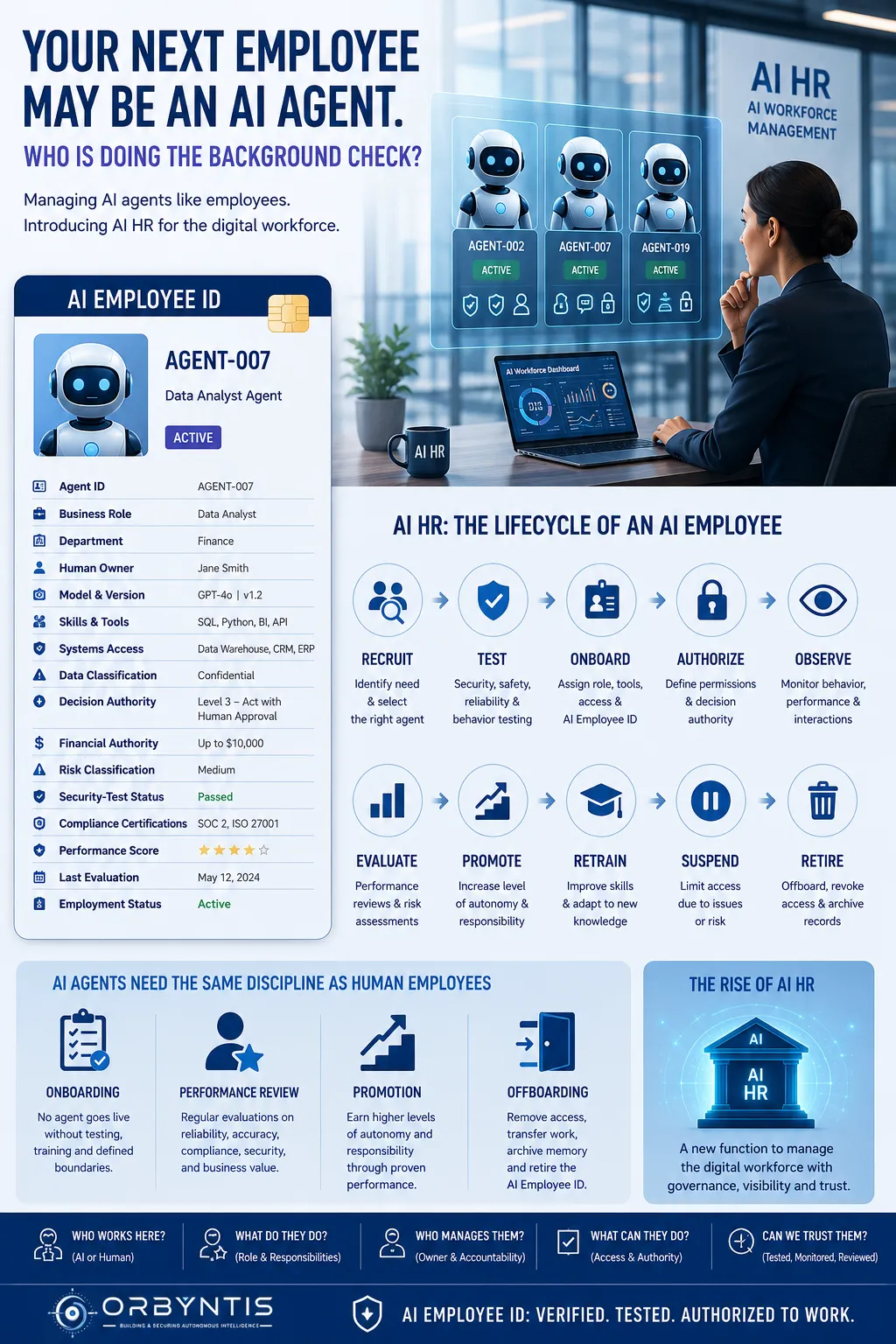
I believe enterprises will eventually assign every production AI agent something similar to an AI Employee ID.
That identity could contain:
- Agent ID
- Business role
- Human owner
- Department
- Model and version
- Skills and tools
- Systems it can access
- Data classification permitted
- Decision authority
- Financial authority
- Risk classification
- Security-test status
- Compliance certifications
- Performance history
- Last evaluation date
- Employment status: Active / Probation / Suspended / Retired
Think of it as the digital equivalent of an employee badge, HR record, security clearance and performance file.
But identity is only the beginning.
AI Agents Need an Onboarding Process
Imagine hiring someone and immediately giving them access to SAP, Salesforce, email, customer records and financial systems without interviewing them, checking their qualifications or establishing what they are allowed to do.
No responsible company would operate that way.
Yet we are dangerously close to doing exactly that with autonomous agents.
Before an agent enters production, it should have to pass an AI onboarding process.
That means testing more than whether the agent technically works.
Can it be manipulated?
Can someone override its instructions?
Will it expose sensitive information?
Can it be tricked into calling the wrong tool?
Will it operate outside its assigned role?
Can another malicious agent influence it?
Does it understand when it needs human approval?
What happens when its goals conflict with company policy?
And perhaps most importantly:
Does this AI employee behave appropriately when nobody is watching?
This starts looking less like traditional software QA and more like a combination of a job interview, background check, security clearance and probation period.
Then Comes the Performance Review
Human employees don’t receive one evaluation on their first day and remain trusted forever.
Neither should AI agents.
Models change.
Prompts change.
Tools change.
Enterprise data changes.
Connected agents change.
Attack techniques change.
An agent that passed every test six months ago may behave very differently today.
So perhaps AI agents need periodic performance reviews.
An AI Agent Performance Review could evaluate dimensions such as:
- Reliability.
- Task completion.
- Hallucination rate.
- Policy compliance.
- Security behavior.
- Decision quality.
- Human escalation rate.
- Cost efficiency.
- Business value delivered.
- Incidents and near misses.
An agent performing well could receive additional capabilities.
In other words, it could be promoted.
Yes, AI Agents May Need Promotions
Today we usually think about agent permissions as technical access controls.
I think we will increasingly think about them as levels of organizational authority.
A new agent might initially be allowed only to observe and recommend.
After sufficient testing and successful operation:
- Level 1: Observe
- Level 2: Recommend
- Level 3: Act with human approval
- Level 4: Act autonomously within defined boundaries
- Level 5: Coordinate other agents
Increasing autonomy should be earned through evidence, not granted simply because an agent was deployed.
That is effectively a career ladder for AI.
And Sometimes an AI Employee Needs to Be Fired
What happens when an agent repeatedly violates policy?
Or its underlying model becomes obsolete?
Or a vulnerability is discovered?
Or another agent performs the same job more safely and efficiently?
Enterprises will need a formal AI offboarding process.
Disable credentials.
Revoke tool access.
Terminate active sessions.
Transfer responsibilities.
Preserve audit history.
Archive relevant memory.
Remove unnecessary data access.
Retire the agent identity.
Just as companies shouldn’t have forgotten employee accounts sitting inside critical systems, they shouldn’t have orphaned AI agents wandering through the enterprise.
The Rise of the AI HR Department
This leads to a bigger idea.
The future enterprise may need a new organizational capability that looks surprisingly similar to Human Resources:
AI Workforce Management.
Its responsibility wouldn’t be payroll and vacation.
It would manage the lifecycle of non-human workers:
Recruit -> Test -> Onboard -> Authorize -> Observe -> Evaluate -> Promote -> Retrain -> Suspend -> Retire
Cybersecurity teams will be essential.
AI governance teams will be essential.
Platform engineering will be essential.
Business owners will be essential.
But someone, or some platform, will eventually have to bring all of these controls together around the lifecycle of the AI employee.
Because once enterprises operate hundreds or thousands of autonomous agents, a simple agent inventory will not be enough.
We will need to know:
- Who works here?
- What job do they perform?
- Who manages them?
- What are they allowed to do?
- Have they been tested?
- How are they performing?
- Can we still trust them?
And when that trust changes:
Should we promote them, retrain them, suspend them, or retire them?
The autonomous enterprise may therefore create an entirely new enterprise function.
Not Human Resources.
AI Resources.
And the first artifact in every AI employee’s file may simply be:
AI Employee ID: Verified. Tested. Authorized to Work.