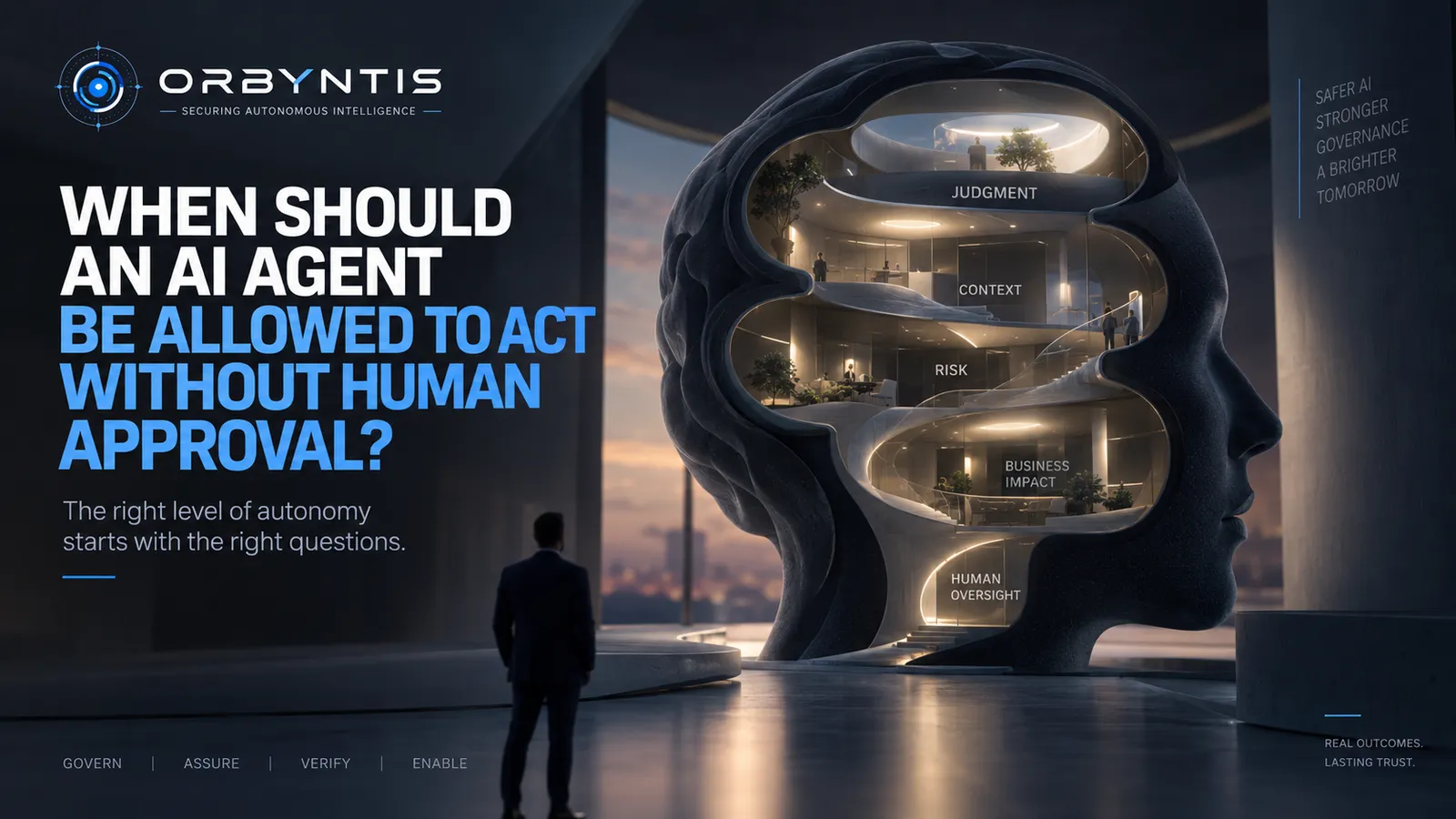
As organizations introduce autonomous AI into business operations, one question appears in nearly every governance discussion:
When should a human approve the agent’s action?
The instinctive answer is often simple:
Keep a human in the loop.
It sounds safe. It sounds responsible. And for some actions, it is absolutely necessary.
But human approval alone does not guarantee human control.
A person clicking “Approve” is only a meaningful safeguard when that person understands the decision, has enough information to evaluate it, and can actually stop the action.
That leads to a more useful question:
Which actions require human judgment, and which can responsibly operate within defined autonomous boundaries?
The goal should not be human approval for every action.
The goal is the right approval for the right consequence.
Human Approval Must Be Meaningful
Consider an employee responsible for reviewing hundreds of AI-generated approval requests every day.
At first, the process appears safe because every important action passes through a person.
But over time, several things can happen.
The reviewer may receive too little context.
The volume may become too high.
Requests may begin to look identical.
Approval becomes routine.
Eventually, the human is no longer exercising meaningful judgment. The organization has added a click between the agent and the action, but not necessarily a control.
This is why human-in-the-loop architectures should be evaluated by their effectiveness, not their existence.
A useful approval should answer three questions:
What is the agent trying to do?
What could happen if the decision is wrong?
Does the reviewer have the information and authority required to stop it?
If those answers are unclear, the approval step may provide less protection than the organization assumes.
Start With Consequence
A useful autonomy model begins with consequence.
An AI agent drafting an internal summary is not equivalent to an agent modifying a production system.
Updating a low-risk ticket is not equivalent to changing a customer’s account.
Preparing a recommendation is not equivalent to moving money.
Organizations therefore need more than one autonomy setting.
The decision should depend on several factors.
Reversibility Changes Risk
Reversibility changes risk.
A draft can be discarded.
A recommendation can be rejected.
A reversible record update can often be corrected.
But a wire transfer, privileged-access change, regulated submission, or public customer commitment may create consequences that are difficult—or impossible—to undo.
The less reversible the action, the stronger the case for explicit approval.
Evaluate the Business Effect
The technical action may be small while the business effect is large.
Changing one value in a system could affect:
- financial reporting,
- production,
- customer access,
- legal obligations,
- sensitive information,
- or regulated records.
Governance should therefore evaluate the business effect, not only the API call.
Consider the Scope of Authority
An agent operating within one narrow workflow is different from an agent with access across multiple systems.
The broader the authority, the greater the potential impact of an incorrect decision.
An agent that can only prepare a report may need very little human intervention.
An agent that can modify production, communicate with customers, access confidential data, and initiate transactions requires a much stronger control model.
Give Reviewers the Evidence They Need
Human approval only works when the reviewer can see what matters.
A useful approval should provide enough evidence to understand:
- what triggered the action,
- which agent is acting,
- which system will be affected,
- what data is involved,
- what will change,
- and why the action is being proposed.
A vague summary such as “Agent recommends proceeding” is not sufficient for a consequential decision.
The quality of the evidence determines the quality of the approval.
Test Containment
Autonomy becomes easier to justify when mistakes can be contained.
Can credentials be revoked?
Can execution be stopped?
Can the action be rolled back?
Can the affected workflow be isolated?
Is there a clearly identified owner when something goes wrong?
Autonomy without containment creates a very different risk profile from autonomy inside a tested control boundary.
Five Operating Levels
Instead of treating autonomy as a binary choice between “human” and “AI,” organizations can use several operating levels.
Level 0 — Suggest
The agent produces recommendations, drafts, or analysis. A person performs the actual business action.
This is often the right starting point for new or high-uncertainty workflows.
Level 1 — Act within fixed limits
The agent can execute clearly defined, low-impact actions within narrow boundaries.
For example, it may update routine records or perform deterministic administrative tasks.
Level 2 — Act autonomously, escalate exceptions
Normal activity proceeds automatically.
Unusual values, sensitive destinations, policy exceptions, or uncertainty trigger human review.
For many enterprise workflows, this is more scalable than approving every individual action.
Level 3 — Human approval for high-impact actions
The agent can prepare and orchestrate the work, but consequential actions require explicit human authorization.
Production changes, privileged access, financial transactions, or significant customer commitments may fall into this category.
Level 4 — Bounded autonomous operation
The agent operates independently inside a defined authority boundary supported by policy enforcement, evidence, monitoring, and tested containment.
This is not unrestricted autonomy.
It is autonomy inside a controlled operating envelope.
Preserve Human Attention
There is another reason not to require approval for everything.
Human attention is finite.
If governance forces employees to review thousands of routine, low-risk actions, the organization may actually weaken oversight of the few decisions that matter most.
Good governance should preserve human attention for:
- ambiguity,
- exceptions,
- high-impact decisions,
- irreversible actions,
- policy conflicts,
- and situations where judgment genuinely matters.
Automation should handle what can be reliably bounded.
Humans should focus on what requires judgment.
This distinction becomes increasingly important as the number of enterprise agents grows.
A governance model that works for five agents may fail when the organization operates five hundred.
Trust the Surrounding Control System
The decision to give an agent more autonomy should not begin with confidence in the model.
It should begin with confidence in the surrounding control system.
Before expanding autonomous authority, organizations should be able to answer:
Who owns this agent?
What can it access?
Which actions can it execute?
Where can those actions occur?
Which policies limit them?
When must the agent escalate?
What evidence is preserved?
How is unsafe behavior contained?
If those answers are unclear, increasing autonomy increases uncertainty.
If those answers are explicit, tested, and reviewable, autonomy becomes a governed operating decision rather than an experiment.
Define the Boundary for Human Judgment
The future of enterprise AI will not be built around a person approving every machine action.
That would remove much of the value autonomy is meant to create.
But the opposite extreme—allowing agents to act freely because they have performed well in testing—is equally problematic.
The better model is bounded autonomy.
Allow agents to act independently where authority is narrow, consequences are understood, controls are tested, and evidence is available.
Escalate when risk or uncertainty moves beyond those boundaries.
Require humans where human judgment materially changes the quality of the decision.
The question is therefore not:
“Should humans stay in the loop?”
The better question is:
“Where does human judgment create a control that the system cannot safely provide on its own?”
That is the boundary enterprises need to define.
Because responsible autonomy is not about removing humans from the process.
It is about putting human judgment where it matters most.