AI control failures do not begin with a regulatory notice.
The system may continue operating normally until one of those gaps reaches a real business action.
They begin earlier: an agent receives broader authority than its task requires. A tool call is tested only under expected conditions. An approval exists on paper but cannot stop execution.
A model, prompt, permission, or data source changes without triggering renewed validation.
By the time an organization is asked to explain what happened, a policy document or monitoring dashboard may not be enough. Reviewers may need to know which identity acted, what information influenced the decision, which control evaluated the request, who approved the action, what changed in the system, and whether the same failure can happen again.
This is where technical uncertainty becomes operational, regulatory, and financial exposure.
Not every missing control automatically creates a fine. Legal obligations depend on the system, its risk classification, the organization’s role, the affected jurisdiction, and the provisions in force. But enterprises should understand the direction clearly: as AI systems gain authority, regulators increasingly expect risk management, testing, traceability, human oversight, documentation, monitoring, and evidence to move with them.
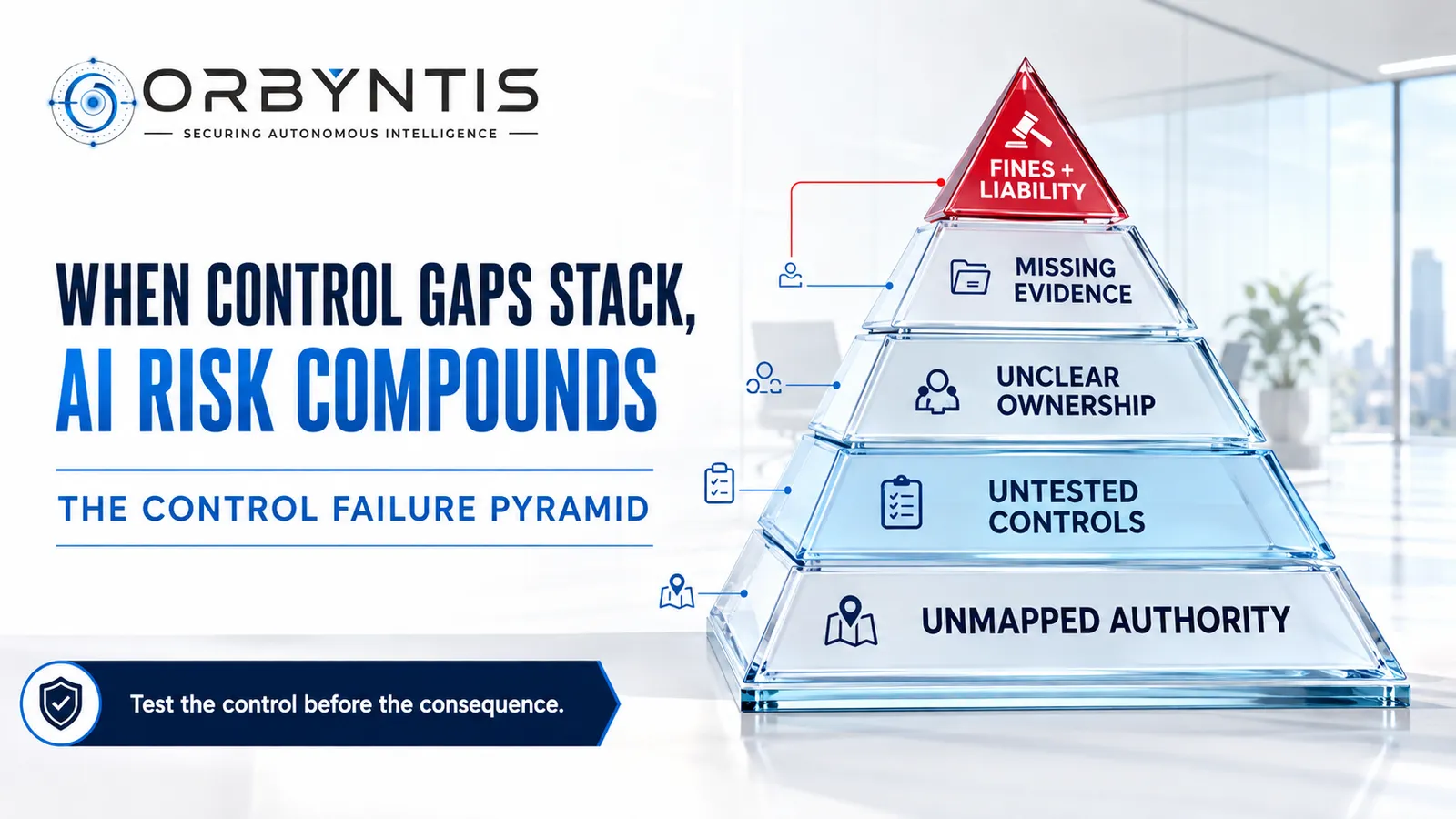
AI risk rarely comes from one isolated weakness. It compounds as several gaps stack on top of one another.
Unmapped Authority
The first gap is often a lack of clarity about what the AI system can actually do.
An enterprise may understand the model and intended use case but still lack a complete view of the operational authority surrounding it:
- Which data can it retrieve?
- Which tools and APIs can it call?
- Which identity or credential does it use?
- Can it create, update, approve, send, delete, or trigger?
- Can it delegate work to another agent?
- Which actions are reversible?
- Which actions can affect customers, records, finances, access, or regulated processes?
Authority should be mapped from the initial request to the final business effect. A model that generates a harmless response may still initiate an unsafe action if the surrounding workflow gives it excessive access.
Until that boundary is visible, neither security teams nor business owners can determine whether the controls are proportionate to the risk.
Untested Controls
Documenting a control does not prove that the control works.
A policy may state that high-impact actions require approval. A system prompt may tell an agent not to disclose sensitive information. A tool description may say that an API is read-only. None of these statements demonstrates how the complete workflow behaves under pressure.
Testing should exercise realistic failure paths, including:
- Direct and indirect prompt injection
- Malicious or conflicting retrieved content
- Unsafe tool parameters and destinations
- Attempts to exceed delegated permissions
- Approval bypass
- Stale or poisoned memory
- Identity confusion
- Unexpected tool responses
- Dependency failures
- Changes to models, prompts, data, tools, or workflow logic
Successful execution is only one part of assurance. Enterprises also need evidence that forbidden actions are rejected, sensitive operations are constrained, and failures move the system into a controlled state.
A model refusing one unsafe request is helpful. It is not proof that the API, identity, approval gate, and business workflow will enforce the same boundary.
Unclear Ownership
A control without an accountable owner can fail silently.
Autonomous AI workflows often cross engineering, security, operations, governance, compliance, and business teams. Each team may own part of the environment while no one owns the final operational decision.
Clear ownership should answer:
- Who approves the initial level of autonomy?
- Who can expand or restrict the system’s authority?
- Who reviews high-impact actions?
- Who receives and investigates runtime alerts?
- Who decides whether the system should continue operating?
- Who owns remediation and retesting?
- Who has the authority to pause or contain unsafe behavior?
Escalation is not complete when an alert enters a queue. It is complete when a named owner accepts the decision rights, response responsibility, and evidence associated with the incident.
Human oversight also needs technical authority. An approver who cannot inspect the relevant context or prevent execution is not functioning as an effective control.
Missing Evidence
Traditional application logs can show that an event occurred. They may not show why the event was allowed, which control made the decision, or who owned the outcome.
Reviewable AI assurance evidence may need to connect:
- The system and workflow version
- Requester, agent, service, and approver identities
- Relevant input or reference identifiers
- The model, prompt, tool, and permission state
- The action requested
- The applicable policy or control
- The authorization and approval result
- The action executed or denied
- The resulting business effect
- The accountable owner
- The time of the decision
- The remediation and retesting status
Evidence collection should remain proportionate and should not become a new source of sensitive-data exposure. The objective is not to store everything. It is to preserve enough context for an authorized reviewer to reconstruct a critical decision.
Without that evidence, an organization may be unable to demonstrate that a control existed, operated as intended, or was improved after a failure.
Fines and Liability
The EU AI Act connects AI risk to concrete expectations for providers and deployers. Depending on the applicable system and obligation, these expectations can include risk assessment and mitigation, dataset quality, activity logging, technical documentation, human oversight, robustness, cybersecurity, accuracy, post-market monitoring, and serious-incident reporting.
The Act became generally applicable on 2 August 2026, although several obligations follow different implementation dates. Under the current European Commission timeline, rules for certain Annex III high-risk use cases are scheduled to apply from 2 December 2027, while rules for high-risk systems embedded in regulated products are scheduled for 2 August 2028. Organizations should therefore evaluate the requirements and dates applicable to their particular role and system rather than treating every AI use case as identical. European Commission: AI Act overview
The financial exposure can be significant.
According to the European Commission’s enforcement overview:
- Infringements involving prohibited AI practices can lead to penalties of up to EUR 35 million or 7% of total worldwide annual turnover.
- Other breaches, including certain obligations concerning general-purpose AI models, can result in penalties of up to EUR 15 million or 3% of worldwide annual turnover.
- Failure to respond to information requests, or supplying incorrect, incomplete, or misleading information, can also produce penalties. For certain AI-system cases, these can reach EUR 7.5 million or 1% of worldwide annual turnover.
The applicable amount depends on the nature, severity, duration, and legal context of the infringement. European Commission: AI Act enforcement framework
The figures attract attention, but the more important enterprise question is what lies underneath them.
A fine may represent the final consequence.
The earlier failures are often operational: an unmapped authority path, an untested control, an owner who was never assigned, a material change that was never reassessed, or evidence that cannot reconstruct the decision.
Changes Restart the Assurance Clock
AI systems do not remain static after their initial review.
A new model can interpret instructions differently. A revised prompt can change tool selection. A new connector can extend the system’s reach. A permission update can turn a proposed action into an executable one. New RAG content can alter the evidence used in a decision. Persistent memory can carry outdated or unauthorized context into a later workflow.
For this reason, assurance should not be treated as a one-time launch activity.
Organizations need criteria for determining when change requires renewed testing. Material changes may include:
- Model or model-version changes
- Prompt and orchestration changes
- New tools, APIs, plugins, or MCP servers
- Modified tool parameters or destinations
- Changes to data sources or retrieval pipelines
- Expanded permissions or credentials
- New memory behavior
- Changes to approval logic
- New agent-to-agent delegation
- Expansion into a higher-impact business process
The objective is not to block every release.
It is to make sure that the evidence supporting yesterday’s decision still describes the system operating today.
An Evidence-Led Assurance Path
Policies, risk registers, and governance frameworks remain important. They become more useful when they are connected to actual system behavior.
A practical assurance path should allow an enterprise to:
- Define the workflow and business effect in scope.
- Map identities, data, tools, permissions, approvals, and actions.
- Identify realistic misuse and failure paths.
- Place deterministic controls close to sensitive business actions.
- Test both successful and denied behavior.
- Assign owners for approval, monitoring, escalation, and remediation.
- Preserve evidence that connects intent, decision, action, and outcome.
- Retest when material system changes occur.
- Monitor sensitive runtime activity.
- Maintain a tested containment and response path.
This is also the assurance path reflected across Orbyntis products.
AgentShield focuses on mapping agent exposure across permissions, tools, memory, identity, and action boundaries. Govern connects autonomous actions to ownership, decision rights, approvals, and review points. CI Gate brings repeatable assurance checks into the delivery path when AI systems change. Evidence Vault organizes evidence created through assessment, validation, and operational review. Runtime Guard focuses on meaningful runtime signals and the response required around sensitive autonomous activity.
The purpose is not to claim that technology alone guarantees compliance.
The purpose is to make authority visible, controls testable, ownership explicit, and evidence reviewable, so technical, business, security, and governance teams can make better decisions about where autonomy should expand, where it should be restricted, and where it should stop.
The cost of uncontrolled AI cannot be measured only after an incident or regulatory decision.
It is already present when an organization cannot explain what an agent is allowed to do. It grows when critical controls are assumed rather than tested. It becomes harder to manage when ownership is unclear. It becomes harder to defend when evidence is incomplete.
Fines and legal liability are important consequences, but they are not the only ones. Enterprises may also face operational disruption, exposed data, incorrect records, customer harm, delayed deployments, failed audits, expensive remediation, and loss of confidence in otherwise valuable AI initiatives.
The strongest response is not fear-driven compliance.
It is evidence-led assurance built into the system before autonomous authority expands.
Map the boundary. Test the failure paths. Assign the owner. Preserve the evidence. Revalidate the system as it changes.
Test the control before the consequence.
This field note provides general information and does not constitute legal advice. Organizations should assess their specific regulatory obligations with qualified legal and compliance professionals.