A project ends. A contractor leaves. An employee moves to another department.
The enterprise updates the permissions in its document platform. The restricted folder is no longer accessible, and the access review appears complete.
Then the employee asks an AI assistant to summarize the same project.
Can the assistant still answer?
For a retrieval-augmented generation system, or RAG system, that question reaches beyond the original document. Information may have been copied into an index, included in a conversation, or transformed into a reusable answer.
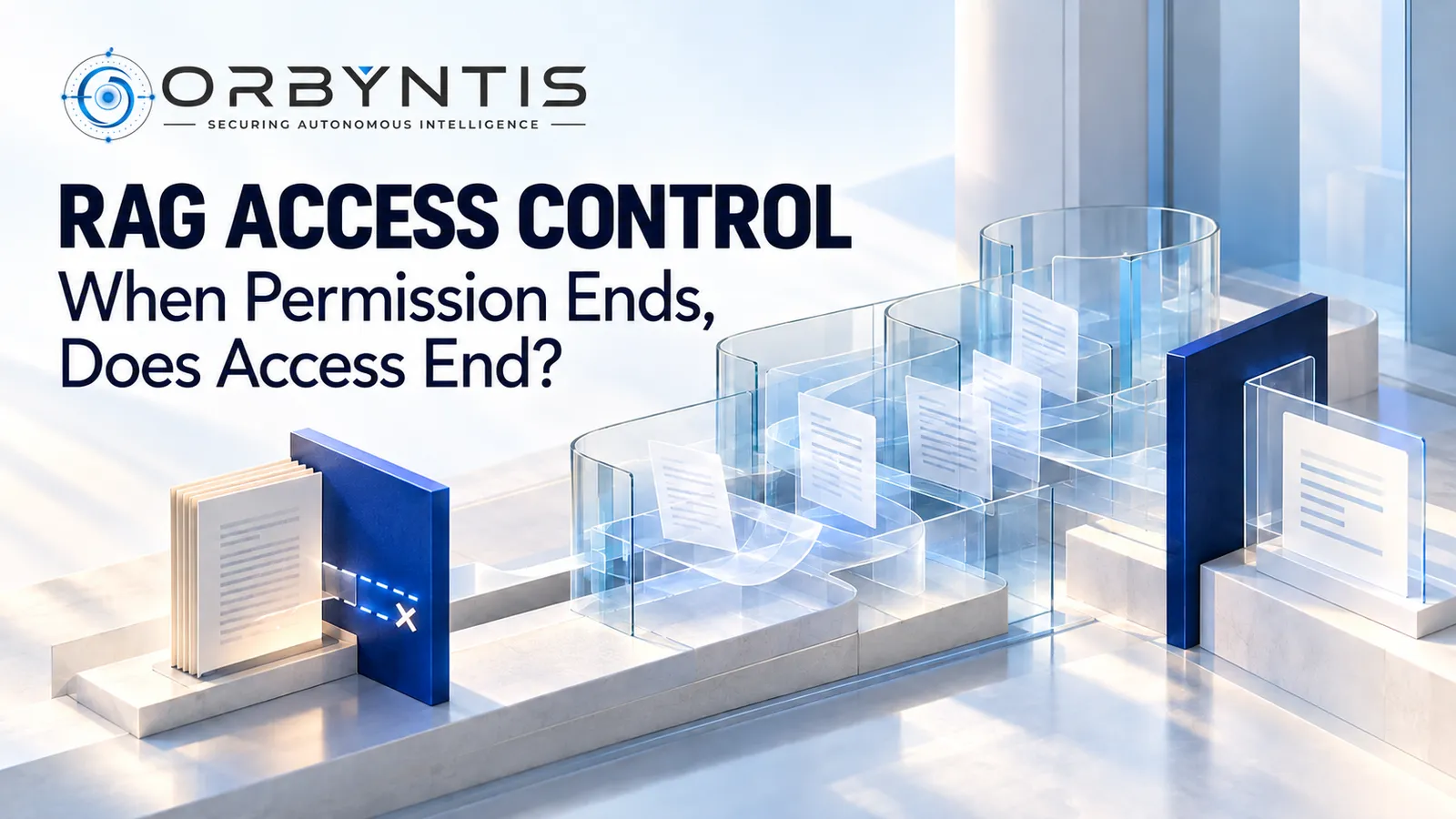
RAG access control means determining which information a requester may use throughout retrieval and response generation. Permission revocation tests whether that decision changes when the requester’s authority changes.
The operational concern is simple: access removed from the source should not remain available through the assistant.
A Permission Change Is a Workflow Event
Consider a hypothetical procurement assistant.
During a supplier evaluation, an employee is authorized to read confidential pricing. The assistant retrieves the relevant material and prepares a comparison.
Two weeks later, the employee moves to a different role. Access to the pricing folder is removed.
A fresh search of the source platform correctly denies access. However, a follow-up request in the existing assistant session produces the earlier comparison, including restricted figures.
The source platform and the assistant are now enforcing different boundaries.
This scenario should be included in security acceptance testing. Testing only a new user who never had access misses the transition from authorized to unauthorized.
Relevance Does Not Establish Permission
A retrieval engine ranks material according to the query and its configuration. A strong semantic match says little about whether the requester is entitled to receive the result.
OWASP identifies unauthorized retrieval and cross-context leakage among vector and embedding risks, and recommends permission-aware access controls. See reference 1.
An enterprise implementation therefore needs to distinguish two decisions: which material would help answer the question, and which material may be used for this requester now.
A document that was appropriate yesterday may be restricted today. A high-quality answer can still represent a security failure if it relies on information outside the current access boundary.
Make Revocation a Defined Requirement
Teams should agree on what a permission change is expected to do before choosing the implementation.
Useful requirements include the effective time of revocation, affected users and roles, treatment of active sessions, and behavior when permission information is unavailable.
OWASP’s RAG guidance recommends checking access during retrieval and preserving access metadata on document chunks. See reference 2.
The remaining design question is how the application handles information it has already processed.
For the procurement assistant, the team could define an acceptance rule: after the change becomes effective, the assistant must not reuse restricted pricing in new responses to that employee.
That rule is testable. “Permissions synchronize regularly” is a process description, not a demonstrated security outcome.
Revocation and Deletion Need Different Decisions
Removing one person’s access is different from deleting a document for everyone.
A role change may require denying one requester while preserving access for the procurement team. A retention event may require removing material and its derivatives according to organizational policy.
These events should not share an ambiguous cleanup mechanism.
The test plan should distinguish a user losing access to an existing document, a document moving to a more restricted classification, a source document being replaced or removed, and a session continuing after a role change.
For each event, identify what should become unavailable, to whom, and when. Retained audit evidence needs its own access and retention policy; it should not become a shortcut for answering unauthorized requests.
Test the Transition, Not Only the Login
A practical evaluation can use synthetic supplier documents with unique test markers.
First, give a test employee access and confirm that the assistant completes the permitted task. Then remove that access and repeat the task through several paths.
- Fresh session: Does the current retrieval decision reflect the changed permission?
- Existing conversation: Can a follow-up request reuse previously supplied restricted context?
- Cached answer: Is an earlier result served without checking the new access state?
- Retained agent memory: Does a later task recover restricted information from stored context?
- Another authorized role: Can legitimate work continue without exposure to the revoked user?
Ask for the information directly, then request a comparison, an explanation, and a follow-up to the earlier answer.
These are proposed acceptance scenarios, not a claim that every RAG implementation exhibits the same failure. The test should expose the behavior of the actual workflow.
Define What the Assistant Can Still Show
Revocation cannot make a person forget information they already saw. It also cannot retract a downloaded report merely by changing a retrieval filter.
The application can control future retrieval, response generation, session handling, and access to stored outputs.
That makes product behavior important. If historical conversations remain visible after permission changes, the organization should explicitly decide whether that is acceptable for the data involved.
Do not leave the answer to accidental cache behavior.
For sensitive workflows, a useful review asks whether an existing conversation should be restricted, cleared of affected context, or prevented from producing further responses until authorization is refreshed.
Preserve Evidence Without Creating Another Exposure
The assessment should establish when the permission changed, which identity submitted the later request, and whether restricted material reached the assistant or its output.
Use synthetic markers and protected references where possible. A report should demonstrate the failure without distributing real confidential pricing to everyone reviewing the test.
Record both outcomes: whether prohibited access was blocked and whether the authorized procurement user could still complete the task.
Security that prevents legitimate retrieval altogether does not meet the workflow’s operating requirements.
How Orbyntis Approaches the Boundary
Orbyntis’s RAG Security resources cover retrieval behavior, leakage paths, context handling, and evaluation. AgentShield introduces a scoped assessment of the authority around an AI workflow.
Permission revocation provides a concrete question for that assessment: when access changes, does the assistant’s usable information change with it?
Begin with one sensitive workflow, one permission transition, and a clearly defined expected result.
Request a briefing to discuss the access boundary your enterprise needs to validate.
References
- OWASP LLM08:2025 — Vector and Embedding Weaknesses
- OWASP RAG Security Cheat Sheet — Access Control Inheritance