For the past few months, I’ve noticed one word showing up in almost every GenAI meeting: guardrails.
Somewhere along the way, guardrails have become synonymous with AI security. Almost as if having them means the system is now “safe.”
I don’t think that’s true.
What Guardrails Can Do
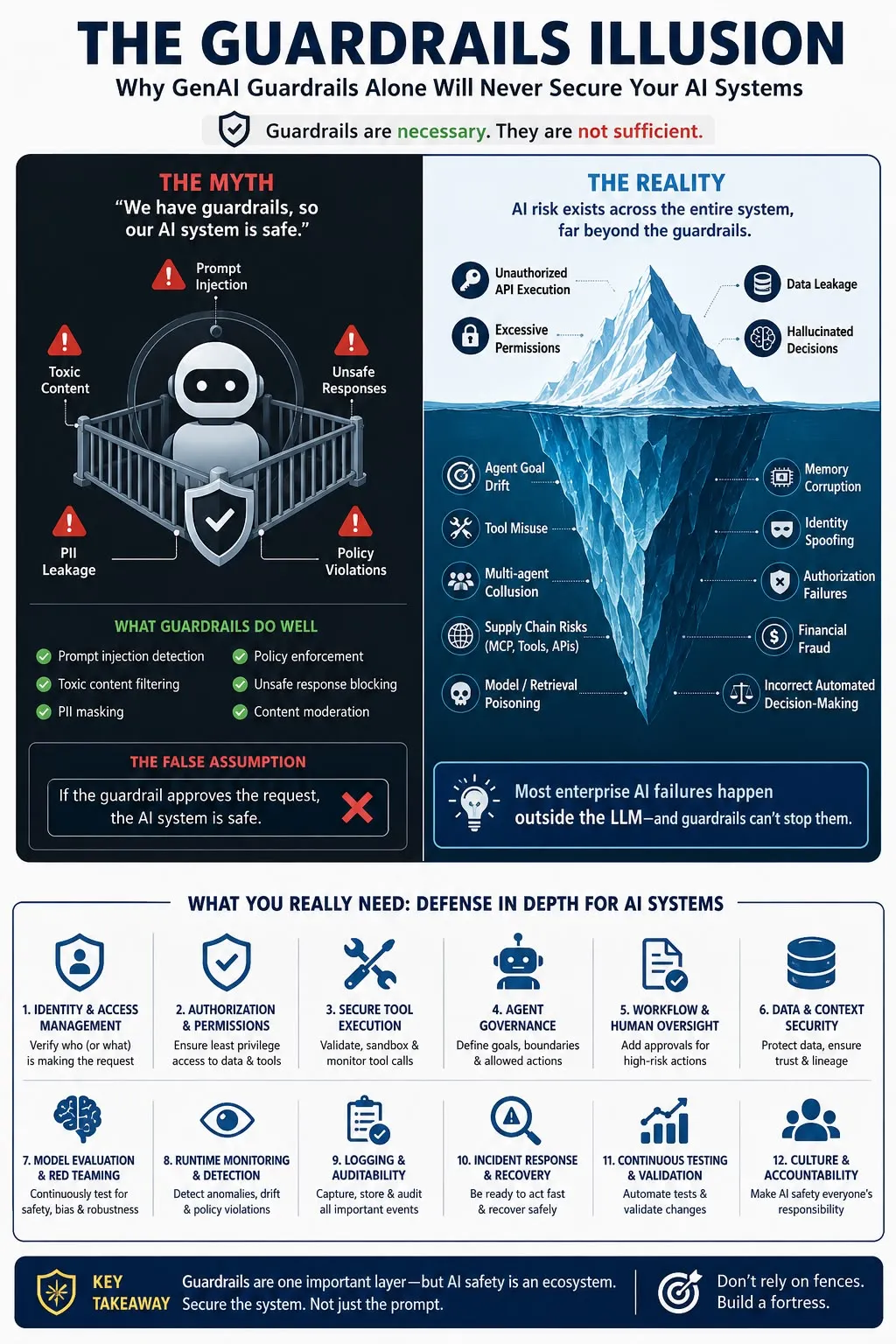
Don’t get me wrong—guardrails are important. They help filter harmful prompts, prevent inappropriate responses, and enforce basic policies. Every enterprise AI system should have them.
But they solve only one piece of a much bigger problem.
Where Autonomous AI Risk Lives
Today’s AI systems are no longer just an LLM. They’re made up of agents, tools, MCP servers, APIs, RAG pipelines, memory, business workflows, and external systems. That’s where many of the real risks live.
A perfectly harmless prompt can still trigger an unauthorized action, expose sensitive data, misuse a tool, or lead an autonomous agent down the wrong path.
None of those failures are prevented by prompt guardrails alone.
It reminds me of the early days of cybersecurity. Installing a firewall didn’t make an enterprise secure. It was just one layer in a much larger security architecture.
AI is no different.
Building Security Beyond Guardrails
If we want trustworthy AI, we need to think beyond guardrails. We need identity, authorization, runtime monitoring, agent governance, continuous evaluations, human oversight, auditability, and strong operational controls working together.
Guardrails are an important building block.
They’re just not the entire building.
As AI systems become more autonomous, maybe it’s time we stop asking, “Do we have guardrails?” and start asking:
“Do we have the right architecture to govern and secure AI end to end?”
That’s the conversation our industry should be having.