Model Context Protocol is making it easier for AI agents to connect with enterprise data, tools, and business systems. That interoperability creates real operational value. It also changes the system’s security boundary.
Every MCP server extends an AI agent’s effective authority.
An MCP server is not simply another connector. It may expose resources the agent can read, tools it can invoke, and actions it can initiate. Once connected, it becomes part of the agent’s effective authority.
Enterprise MCP security therefore begins with a practical question: what new capability does this server give the agent, under whose identity, and with what evidence?
What MCP Security Needs to Control
MCP security is the discipline of controlling how AI clients discover, access, and use resources and tools exposed through Model Context Protocol servers.
A secure implementation must protect more than the connection itself. It must control:
- Which MCP servers are trusted
- Which resources and tools each server exposes
- Which identity is used for each request
- Which operations the agent may perform
- Which parameters, destinations, and data classes are permitted
- When human approval is required
- What evidence is retained after the action
The official MCP authorization specification defines an OAuth-based authorization model for protected HTTP deployments. However, protocol-level authorization does not by itself determine whether a business action is appropriate. Enterprises still need workflow-specific controls around the tools and authority exposed to the agent. MCP Authorization Specification
The Boundary Now Reaches the Business Action
Without connected tools, a model may generate an inaccurate or unsafe response. With MCP-enabled tools, the same model may retrieve customer records, update a ticket, access a repository, send a message, modify a document, or initiate a business workflow.
The risk is no longer limited to model output. It extends across the full path:
Requester -> AI agent -> MCP client -> MCP server -> downstream system -> business action
Every component in this path can influence the outcome. A narrowly designed agent can become over-privileged when a new MCP server is introduced, an existing server exposes additional tools, or a downstream API changes its permission model.
This is why MCP servers should be treated as extensions of the agent’s authority boundary rather than ordinary application integrations.
Capability Should Not Become Standing Authority
An MCP server may expose more tools than a particular workflow requires. A support agent that only needs to read case status, for example, should not automatically receive the ability to close cases, export records, or change customer attributes.
Broad scopes increase the impact of prompt injection, model error, credential compromise, and unintended tool selection. The MCP security guidance recommends minimizing requested scopes because overly broad access increases compromise impact and makes accountability harder. MCP Security Best Practices
Permission design should begin with the business task, not the complete capability of the connected system.
Identity Must Stay Distinguishable
An enterprise workflow may involve several identities:
- The human requester
- The AI agent
- The MCP client
- The MCP server
- A service account
- The downstream API user
- The human approver
If these identities are collapsed into one broadly privileged account, reviewers may be unable to determine who requested an action, whose permissions authorized it, or which component executed it.
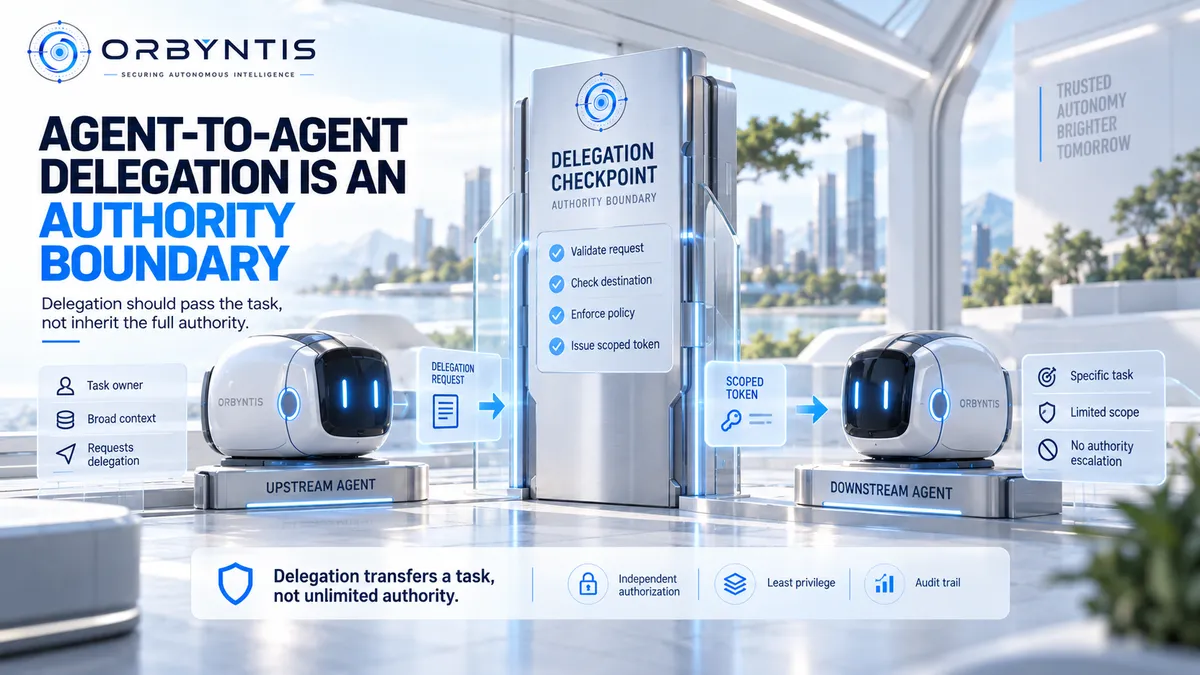
Token passthrough is a particularly important failure pattern. It occurs when an MCP server accepts a token without confirming that it was issued for that server and forwards it to another service. Official MCP guidance warns that this can weaken security controls, obscure audit trails, and turn the server into a path for unauthorized access or data exfiltration.
Each protected service should validate that the token was intended for it. Downstream access should use explicitly controlled credentials rather than an unverified token received from another trust boundary.
Treat External Content as Data
MCP resources and tool responses can carry content into an agent’s decision process. That content may come from documents, tickets, webpages, repositories, messages, or external services.
If retrieved content contains misleading or malicious instructions, a normal data-access step can become an indirect prompt-injection path. The danger becomes greater when the same agent can act through privileged tools.
External content should be treated as data, not authority.
Tool calls should be validated independently of the model, particularly when an action affects sensitive information, money, permissions, production systems, or customer records.
The Orbyntis Autonomous AI Threat Library describes this connection between untrusted context, tool misuse, excessive agency, and business impact.
Change Control Must Follow the Integration
MCP servers are active dependencies. Their tool definitions, schemas, authentication methods, underlying packages, hosting environments, and downstream services may change.
A previously reviewed integration may become materially different when:
- A tool is added or renamed
- A parameter becomes optional
- A permission scope expands
- A server package is updated
- The downstream API changes
- A new data source becomes accessible
- Approval logic moves to another component
- The agent’s model or system prompt changes
Change control should therefore cover the full agent-to-action path. A successful assessment at launch does not prove that the same controls remain effective after the system changes.
Evidence Is Part of the Security Boundary
Traditional API logs may show that a request occurred without explaining why the agent selected the tool, which requester initiated the workflow, what policy was evaluated, or whether an approval was required.
For a sensitive MCP-enabled action, a reviewable evidence record should connect:
- Requester and agent identity
- MCP client and server identity
- Selected resource or tool
- Input parameters and destination
- Relevant context provenance
- Permission and policy result
- Approval decision
- Executed action
- Downstream response
- Business outcome
- Accountable owner
The objective is not to collect every prompt or duplicate sensitive information unnecessarily. The objective is to preserve enough evidence to reconstruct the decision and verify that the intended controls operated.
OAuth Is Necessary, Not Sufficient
OAuth can establish whether a client has access to a protected MCP server. It does not determine whether every action available through that server is appropriate for a particular workflow.
A token may be valid while the requested action is still unsafe.
Enterprise controls should therefore operate close to the business action. Depending on the workflow, this may include:
- Operation-level permissions
- Tool allowlists
- Parameter validation
- Destination restrictions
- Tenant and data-classification checks
- Transaction and rate limits
- Separation of propose, approve, and execute privileges
- Human approval for irreversible actions
- Safe failure and containment behavior
These protections should be deterministic. The agent may help form a request, but it should not be the only component deciding whether its own action is authorized.
This aligns with the Orbyntis AI Agent Security model: useful autonomy requires visible authority, enforceable controls, and reviewable evidence.
A Five-Stage MCP Assurance Path
A defensible MCP deployment can be evaluated through five stages.
- Create an inventory of every MCP server, exposed resource, available tool, downstream system, identity, permission, and data class. Associate each integration with a business workflow and an accountable owner.
- Document what the agent may read, propose, modify, approve, and execute. Separate required capabilities from functionality that happens to be available through the connected server.
- Test more than successful tool use. Attempt unauthorized tool invocation, unsafe parameters, cross-user access, indirect prompt injection, approval bypass, token audience failures, data exfiltration, downstream failure, and stale or conflicting context.
- Record identity, context source, selected tool, policy result, approval, action, and outcome in a connected evidence chain. Assign ownership for review, remediation, and continued operation.
- Trigger reassessment when an MCP server, tool schema, permission, model, prompt, retrieval source, workflow, or downstream service changes.
The important result is not simply that the model refused an instruction. The test should prove that the enforcement point prevented the prohibited action.
Runtime monitoring should also be able to pause, restrict, or downgrade the workflow when expected control signals disappear.
How Orbyntis Treats MCP Exposure
Orbyntis treats MCP exposure as part of the complete autonomous AI assurance path.
AgentShield begins by mapping permissions, tools, integrations, identities, approvals, memory, and action boundaries. This makes the authority introduced by an MCP server visible before the workflow reaches business-critical operation.
The broader Orbyntis assurance path connects that initial exposure assessment with evidence preservation, accountability, change validation, and runtime monitoring. The goal is to help engineering, security, governance, and operations teams answer the same core questions throughout the system lifecycle:
- What can the agent do?
- Which control decides whether it may do it?
- Who owns the decision?
- Can the organization prove what happened?
- Does that proof remain valid after the system changes?
MCP Security Checklist
Before connecting an MCP server to an enterprise AI agent, confirm that:
- The server, tools, resources, owner, and environment are inventoried.
- The workflow uses only the tools and scopes it actually requires.
- Requester, agent, service, and approver identities remain distinguishable.
- Tokens are audience-bound, validated, and never passed through without verification.
- Untrusted resources and tool outputs cannot become privileged instructions.
- Sensitive operations enforce permissions outside the model.
- High-impact or irreversible actions require appropriate approval.
- Tool parameters, destinations, transaction values, and data classes are validated.
- Evidence connects intent, identity, control decision, action, and outcome.
- Material changes trigger reassessment.
- Operators can contain or downgrade unsafe operation.
MCP provides a standard way for AI applications to connect with external capabilities. Security depends on how the client, server, authorization flow, permissions, downstream systems, and business controls are implemented. A compliant connection can still expose excessive authority if the surrounding workflow is poorly scoped.
No. OAuth helps control access to a protected server. Enterprises must still determine which tools may be used, which actions are appropriate, which parameters are permitted, when approval is required, and what evidence must be retained.
Token passthrough occurs when an MCP server accepts a token without confirming that it was issued for that server and forwards it to a downstream service. This can break trust boundaries, weaken auditability, and allow tokens to be used outside their intended audience.
Retesting should follow material changes to the MCP server, exposed tools, schemas, scopes, identities, model, prompts, retrieval sources, approval logic, or downstream APIs. Runtime evidence should also trigger review when the observed system no longer matches the approved operating state.
MCP can accelerate the integration of AI agents with enterprise systems. That value is strongest when every new capability is matched with an explicit identity, narrow permission, independent enforcement point, accountable owner, and reviewable evidence trail.
Connecting the server enables the capability. Assurance determines whether the capability can be trusted in operation.
Explore enterprise assurance for autonomous AI at Orbyntis.