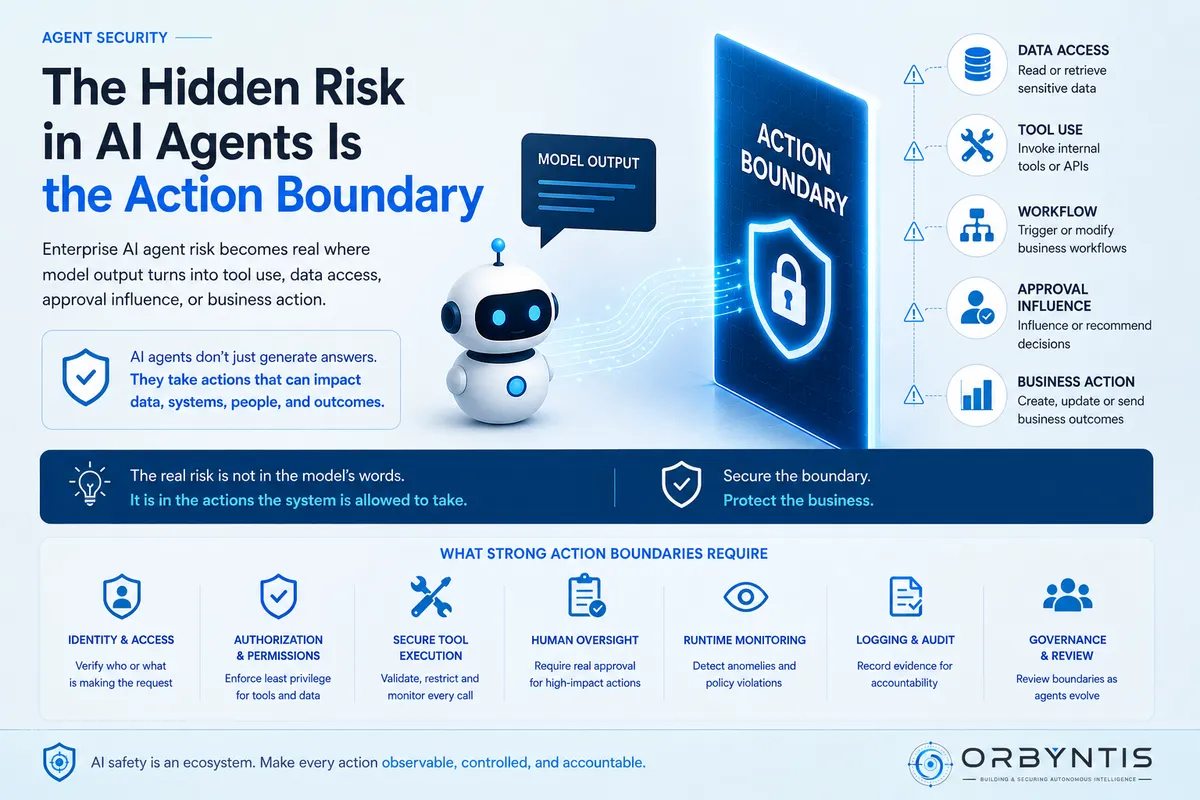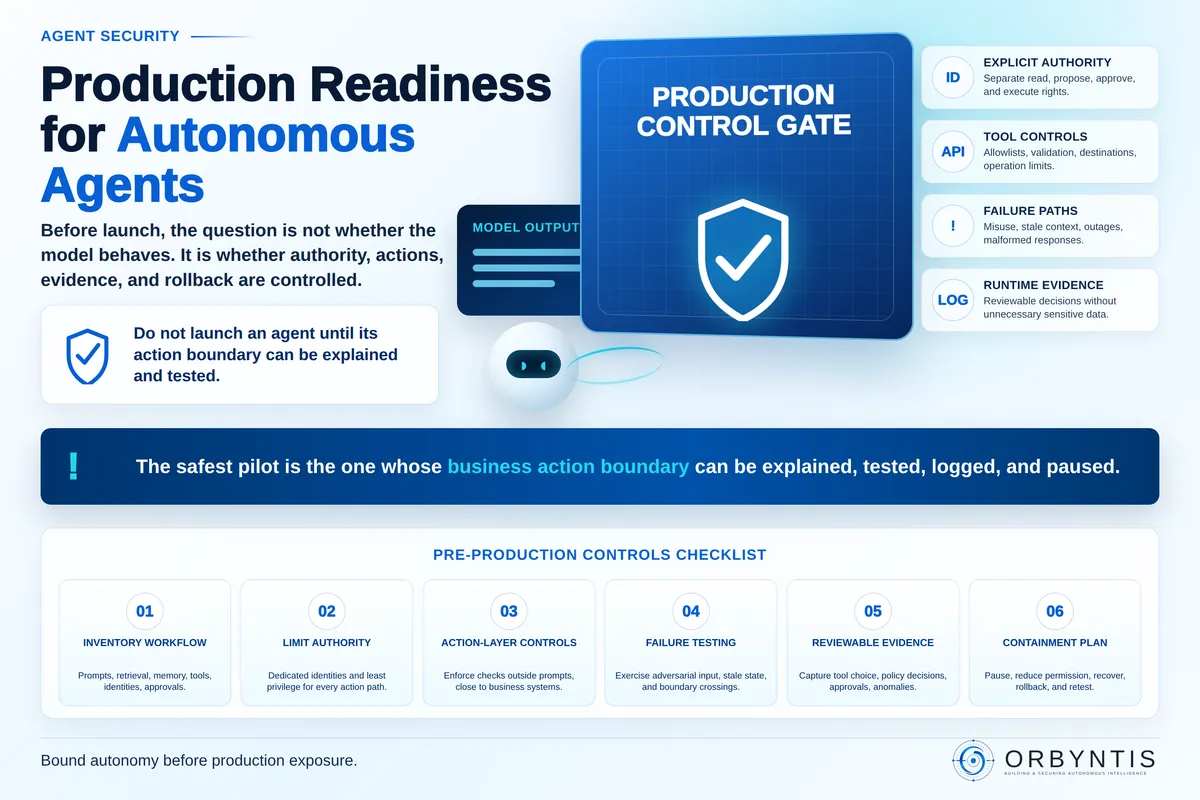
Autonomous AI systems are moving beyond single-agent architectures.
A planner may delegate research to one agent, analysis to another, and execution to a third. Specialized agents can make systems more capable, modular, and easier to scale.
But every delegation introduces a security question that is easy to overlook:
What authority is actually being transferred?
A task may need to move from one agent to another. That does not mean the receiving agent should inherit the delegating agent’s credentials, permissions, approval state, or access to every downstream system.
The distinction matters.
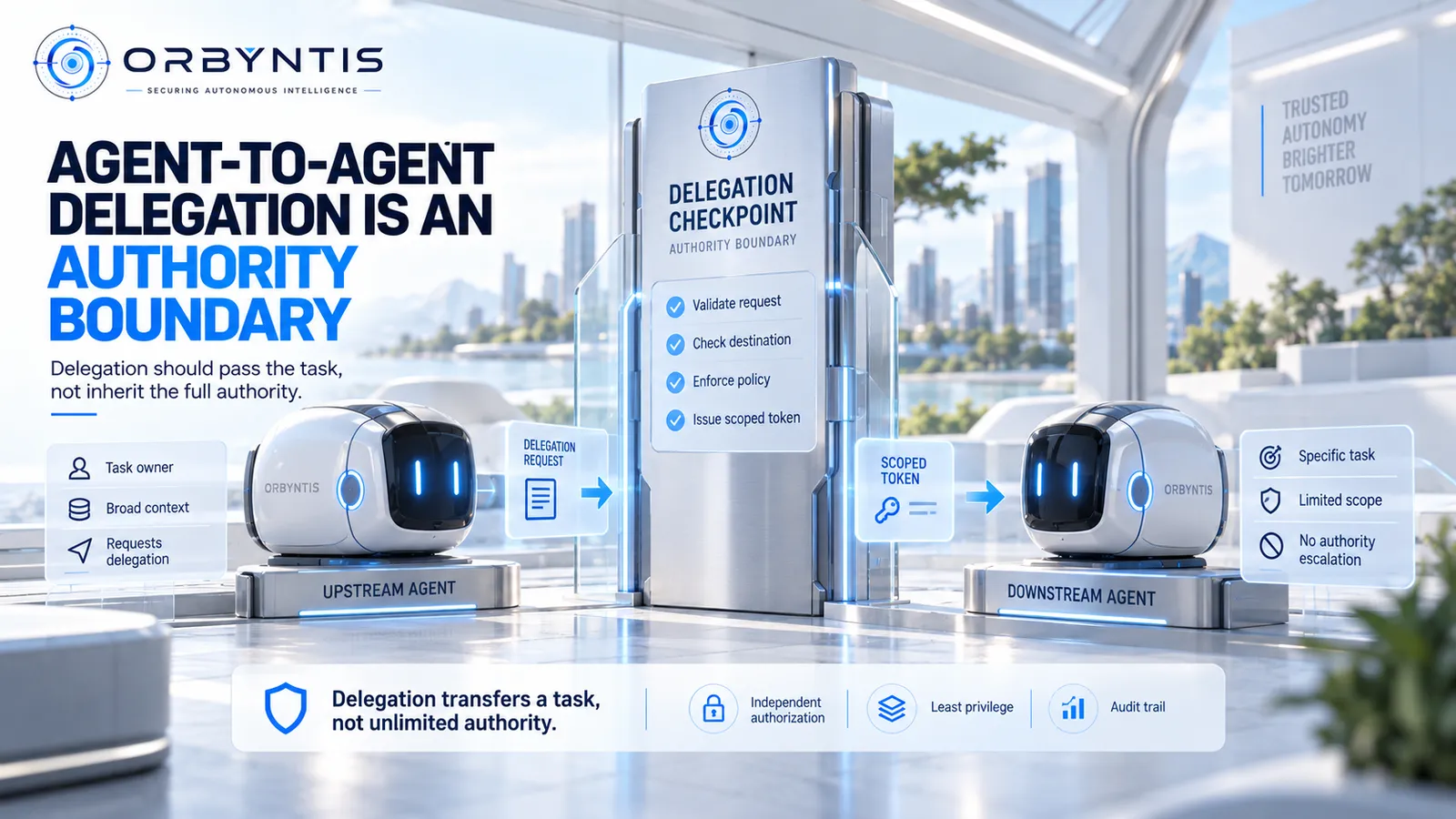
Delegation should transfer a task, not automatically transfer authority.
When Delegation Transfers Too Much
Consider a simple enterprise workflow.
A user asks a planning agent to analyze an issue and prepare a recommendation. The planning agent has read access to an SAP environment and permission to propose specific business actions.
It then delegates part of the work to an execution agent.
A naïve implementation might look like this:
User → Planner Agent → Executor Agent → SAP
The executor receives the planner’s service identity or operates through the same credential context.
From an application perspective, this can appear efficient. From an authority perspective, it creates ambiguity.
The executor may now be able to do more than the delegated task requires.
It may inherit:
- broader data access,
- write permissions,
- access to unrelated tools,
- downstream destinations,
- approval context,
- or credentials that were never intended for it.
The system has transferred more than work.
It has transferred authority.
Delegation Is a Security Boundary
That turns delegation into a security boundary.
A downstream agent should not be trusted simply because an upstream agent selected it.
Before the receiving agent acts, the system should independently determine:
Who initiated the original request?
Which agent delegated the task?
What exact operation is being delegated?
Which destination may the receiving agent reach?
Which data may it access?
How long should that authority remain valid?
Can the receiving agent delegate again?
These questions should be answered before execution, not reconstructed after something goes wrong.
A safer architecture looks closer to this:
User Intent → Planner Agent → Delegation Policy → Scoped Identity → Executor Agent → Independent Authorization → Tool → Evidence
The executor receives only the authority necessary to perform the delegated task.
Nothing more.
Narrow Authority at Every Handoff
Authority should become narrower as work moves through a multi-agent system.
If Agent A can:
- read ten datasets,
- use five tools,
- reach three environments,
- and request two types of changes,
Agent B should not automatically receive the same scope.
If Agent B only needs one dataset and one read-only operation, that is the authority it should receive.
This is scope attenuation.
The same principle already exists in mature identity and access management architectures: delegated rights should be constrained to the minimum required for a specific operation.
Agentic systems need the same discipline.
Otherwise, an agent graph becomes an authority amplification mechanism.
Short-Lived, Scoped Credentials
Shared service accounts make delegation difficult to govern.
If multiple agents act under the same identity, the system may be able to record what happened but still fail to establish who had the authority to initiate it.
Short-lived, scoped credentials provide a stronger model.
A delegated identity can encode constraints such as:
- permitted operation,
- approved destination,
- accessible dataset,
- maximum value or transaction range,
- expiration time,
- non-transferability,
- and originating agent.
The credential becomes a technical expression of the delegated authority.
More importantly, it can expire.
Delegated access that remains valid long after the original task has ended creates unnecessary exposure.
Trust Must Not Propagate Silently
Multi-agent systems introduce another problem: transitive trust.
Suppose Agent A is approved to delegate to Agent B.
Agent B can delegate to Agent C.
Does that mean Agent A—or the human who initiated the workflow—has implicitly authorized Agent C?
Not necessarily.
Trust should not silently propagate across the agent graph.
A trusts B and B trusts C does not automatically mean A authorizes C.
Every new delegation can introduce:
- a new identity,
- a new runtime,
- a new model,
- a new tool set,
- a new owner,
- and a new security posture.
The chain should therefore be evaluated at every handoff.
Dynamic agent discovery makes this even more important. If agents can select new downstream agents at runtime, then the authority graph is changing while the workflow is executing.
That change needs governance.
Preserve the Original Requester
Delegation can also create a modern version of the confused-deputy problem.
A lower-privileged agent may convince a more privileged agent to perform an action on its behalf.
The request may appear legitimate because the privileged agent is technically allowed to execute the operation.
But authorization should not be based only on the executor’s permissions.
The system must preserve the context of the original requester.
The relevant question is not simply:
“Can this agent execute the operation?”
It is:
“Is this operation authorized for this requester, through this delegation chain, against this destination, under the current policy?”
That requires identity and intent to survive the entire workflow.
Validate the Real Action
A delegation decision should not become a blanket approval for everything that happens downstream.
Each receiving agent should validate at least three things before execution:
Operation — What action is actually being requested?
Destination — Where will that action occur?
Parameters — Are the values, targets, scope, and context still acceptable?
This becomes particularly important when agents transform instructions.
A planner may delegate “prepare the approved customer update.”
A downstream agent may translate that into a tool call affecting multiple customer records.
The semantic intent may look similar while the operational effect is very different.
Authority needs to follow the real action, not merely the natural-language description of the task.
Bind Approvals to Scope
Human approval creates another delegation challenge.
Suppose a human approves Agent A’s proposed action.
Agent A later delegates part of that action to Agent B.
Should Agent B inherit the approval?
Only if the approved scope is still identical.
If the downstream agent changes:
- the target,
- the operation,
- the amount,
- the environment,
- the timing,
- or the business effect,
the original approval may no longer apply.
Approvals should therefore be bound to clearly defined conditions.
An approval without scope is not a reliable control.
Revocation Needs Lineage
Delegated authority also needs a revocation model.
If Agent A loses permission during execution, what happens to Agent B?
What about Agent C, which received a delegated credential from B?
Revoking only the upstream identity while allowing downstream agents to continue operating can leave stale authority active inside the system.
Delegation therefore needs lineage.
The system should know:
who delegated what, to whom, under which policy, for how long, and with which downstream dependencies.
Revocation can then propagate across the affected chain.
Reconstruct the Authority Chain
Traditional application logs often show individual events.
Multi-agent governance requires more.
For a critical action, the enterprise should be able to reconstruct:
Requester → Delegating Agent → Receiving Agent → Authorization Decision → Tool → Destination → Business Effect
That evidence should show more than timestamps.
It should explain:
- which identity acted,
- what authority was available,
- what authority was delegated,
- which policy allowed the delegation,
- whether the scope changed,
- what tool executed the action,
- and what business outcome followed.
Without that chain, accountability becomes fragmented across agents.
The system may know what happened without being able to explain why it was allowed to happen.
Design Authority Graphs, Not Only Orchestration Graphs
The most important architectural shift is to stop thinking about multi-agent systems only as orchestration graphs.
They are also authority graphs.
Every new agent can introduce:
- another trust relationship,
- another credential path,
- another tool boundary,
- another destination,
- and another potential escalation route.
That means agent-to-agent delegation deserves the same level of design attention as API authorization, privileged access, and service-to-service identity.
The architecture should make authority narrower, visible, revocable, and reconstructable at every handoff.
The principle is straightforward:
Delegate the task. Re-evaluate the authority.
Autonomous systems become significantly harder to govern when one agent can silently transfer its effective permissions to another.
A scalable multi-agent architecture therefore requires more than good orchestration.
It requires explicit authority boundaries between agents.