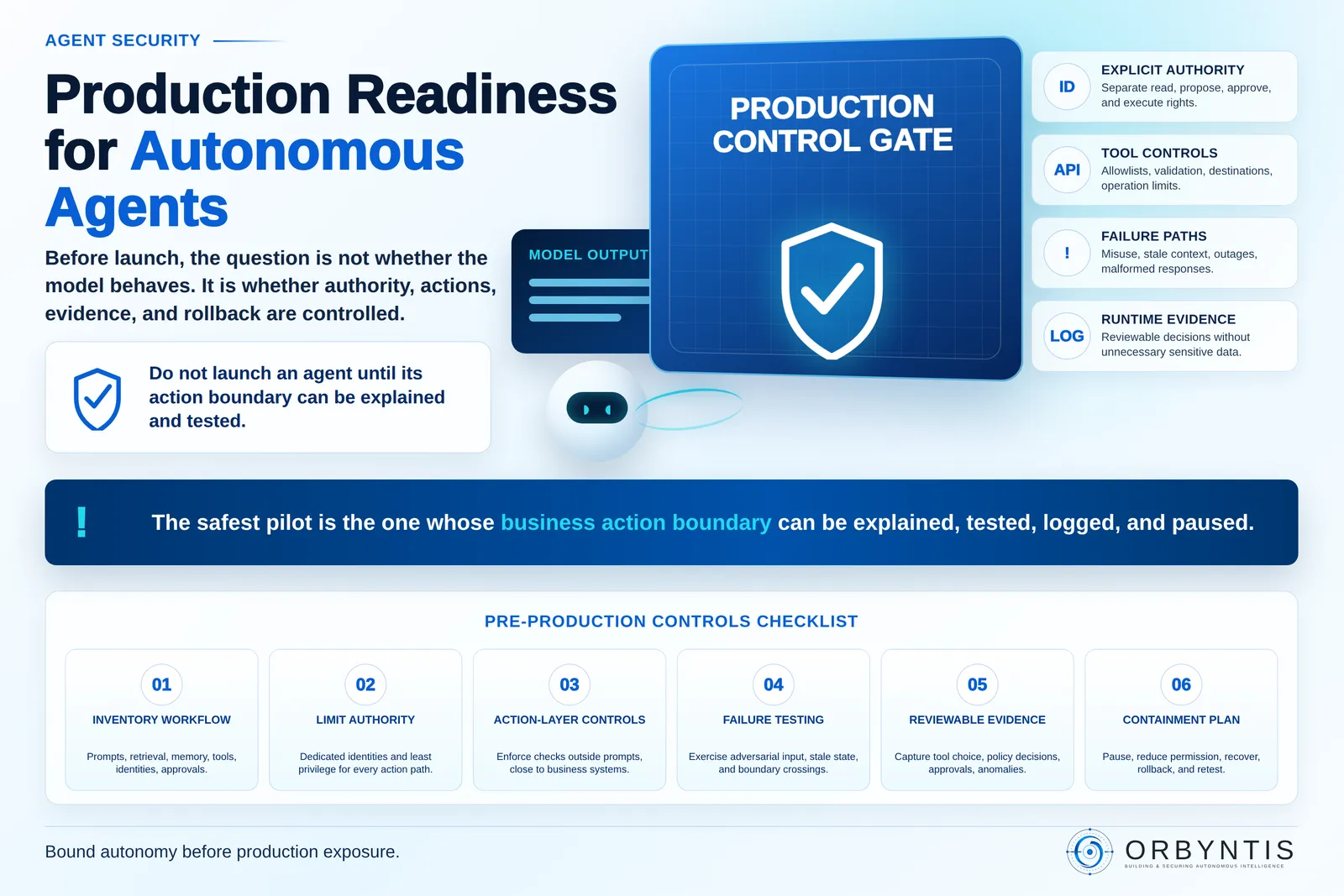
AI agents become materially different from chat interfaces when they can retrieve private context, assume an identity, call tools, modify records, or influence an approval. Before production, an enterprise team should be able to explain the agent’s authority, the controls around each sensitive action, and the evidence available when behavior does not match expectations.
The practical objective is bounded autonomy: the agent can perform its intended work, but its access, actions, and failure modes remain understandable and controllable.
1. Inventory the Complete Workflow
Start with a system inventory that follows the workflow from input to business effect. Include:
- Models, prompts, orchestration logic, and routing decisions
- Retrieved data, memory, caches, and external content
- Tools, APIs, plugins, and connected business systems
- Human users, service identities, credentials, and delegated permissions
- Approval points, queues, logs, alerts, and incident owners
Do not stop at an architecture diagram of the model layer. If an agent reads a document, selects a tool, calls an API, and asks a person to approve the result, every transition is part of the security boundary.
The NIST AI Risk Management Framework is useful here because it treats AI risk as an organizational and operational concern, not only a model-quality problem.
2. Define Authority Explicitly
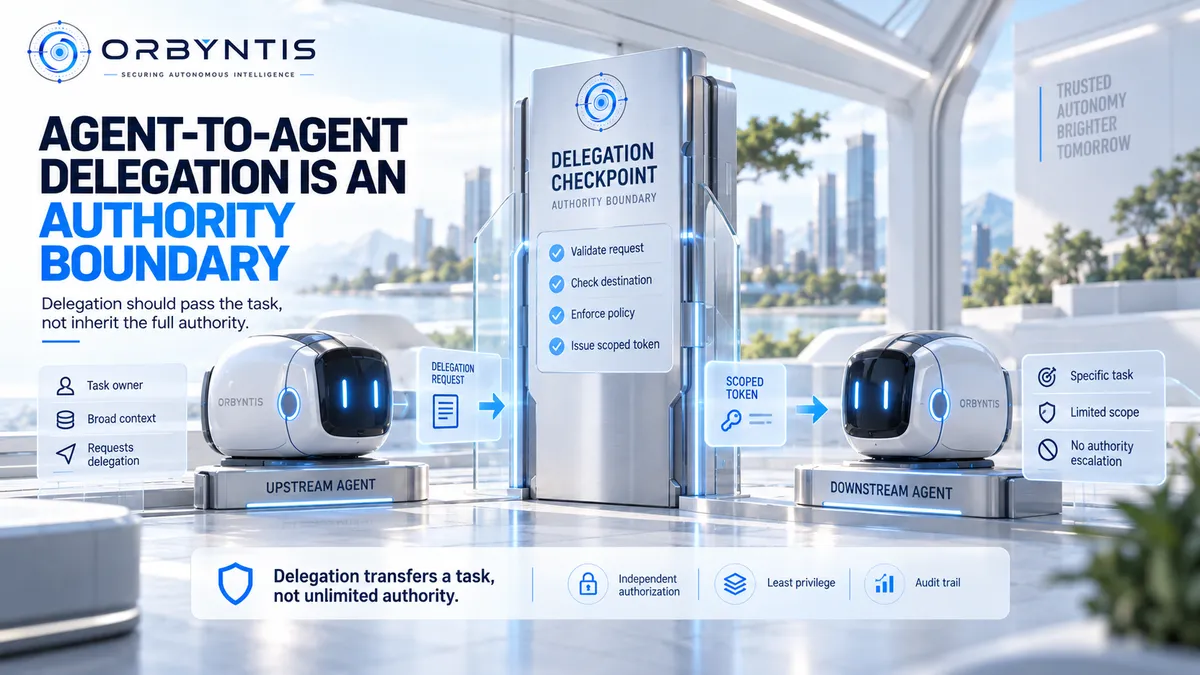
For each identity and tool, document what the agent can see and change. Separate read, propose, approve, and execute permissions wherever the workflow allows it. A useful review asks:
- What is the minimum information required for this task?
- Which actions are reversible?
- Which actions create financial, legal, safety, or customer impact?
- Can the agent acquire new permissions indirectly through another tool?
- Does a human approval actually constrain execution, or merely acknowledge it?
Use dedicated identities rather than shared credentials. Restrict tokens to the required systems and operations. Avoid giving a single agent broad standing access simply because multiple future use cases are anticipated.
3. Threat Model Context and Tool Use
Prompt injection remains important, but enterprise risk also includes malicious retrieved content, excessive permissions, stale memory, identity confusion, unsafe tool combinations, data leakage, and approval bypass.
Threat modeling should connect attacker input to an asset or business outcome. For example, a document-based injection matters because it may change which tool the agent calls, what information it discloses, or how it frames a request for human approval.
The OWASP guidance for large language model applications and MITRE ATLAS provide useful starting points for abuse cases. They should be adapted to the actual workflow rather than copied into a generic checklist.
4. Put Controls at the Action Boundary
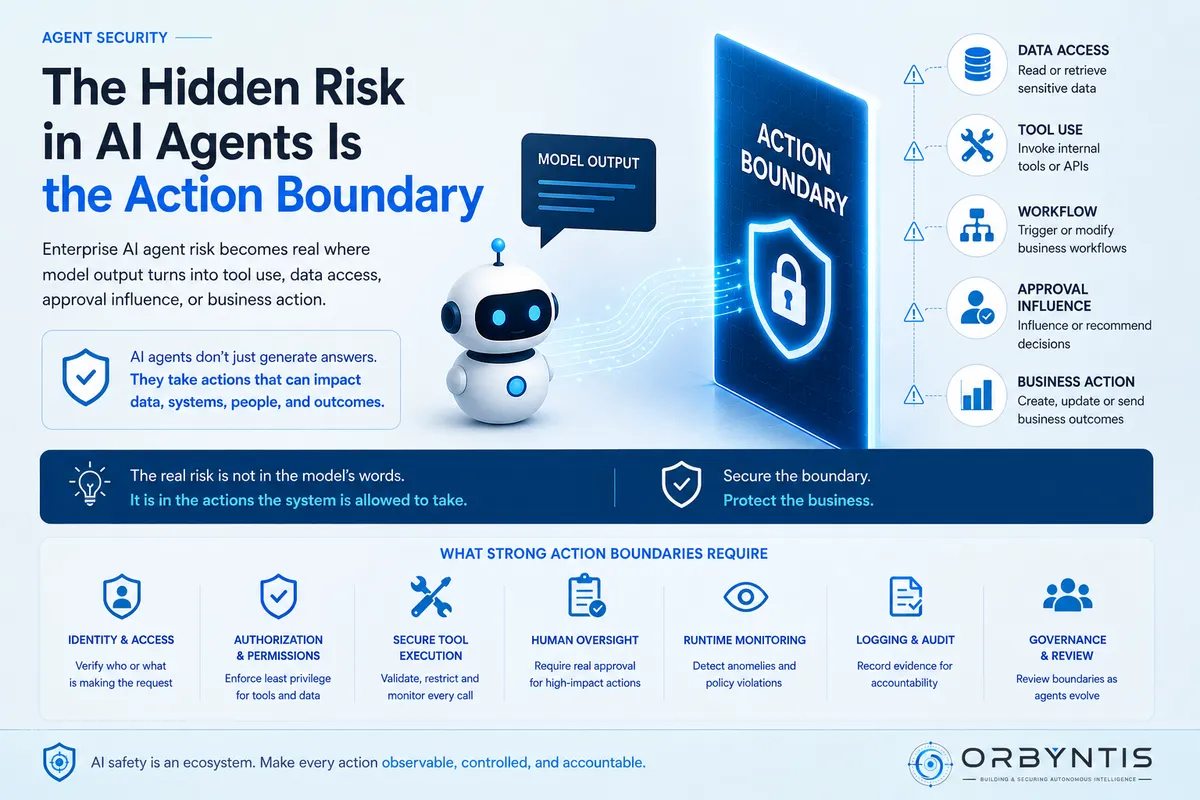
System prompts and model instructions are useful behavioral inputs, but they are not authorization controls. Enforce sensitive boundaries in deterministic application or infrastructure logic.
Controls may include:
- Tool allowlists and operation-level permissions
- Parameter validation and destination restrictions
- Data classification checks before retrieval or disclosure
- Transaction limits, rate limits, and bounded execution windows
- Human approval for high-impact or irreversible actions
- Isolation between untrusted content and privileged instructions
- Safe failure behavior when policy or confidence checks cannot complete
The strongest control is usually placed close to the business action. A payment API, for example, should enforce authorization even if the agent believes the request is legitimate.
5. Test Realistic Failure Paths
Pre-production validation should exercise the complete workflow. Include expected use, accidental misuse, adversarial input, unavailable dependencies, stale context, malformed tool responses, and attempts to cross permission boundaries.
Capture the input, relevant system state, action selected, control decision, resulting business effect, and remediation status. Tests should be repeatable so the team can verify a fix after prompts, models, tools, or permissions change.
Avoid declaring the system secure because it rejected a small library of prompts. The question is whether meaningful controls continue to work when inputs and system state vary.
6. Prepare Runtime Evidence and Response
Before launch, define which events must be observable without storing unnecessary sensitive content. Useful signals include tool selection, authorization decisions, approval events, policy failures, unusual action sequences, and attempts to access restricted resources.
Assign owners for alert review, containment, evidence preservation, and recovery. Establish conditions that pause the agent, reduce its permissions, or return the workflow to manual operation. An incident plan should not depend on the same agent that may be behaving unexpectedly.
Production Readiness Questions
An approval group should be able to answer these questions with evidence:
- Is the agent’s authority documented and limited to the intended workflow?
- Are high-impact actions protected outside the model?
- Has realistic adversarial and failure testing been completed?
- Can operators reconstruct important decisions without excessive data collection?
- Are ownership, escalation, containment, and rollback paths defined?
- Will material changes trigger reassessment and retesting?
If the answers are incomplete, narrow the pilot rather than accepting an undefined risk boundary. Production readiness is not a claim that failure is impossible. It is evidence that authority is bounded, important failures are anticipated, and the organization can detect and respond when reality differs from the design.
Explore Orbyntis Agent Security & Runtime Risk Assessment or read what AI red teaming means for autonomous workflows.