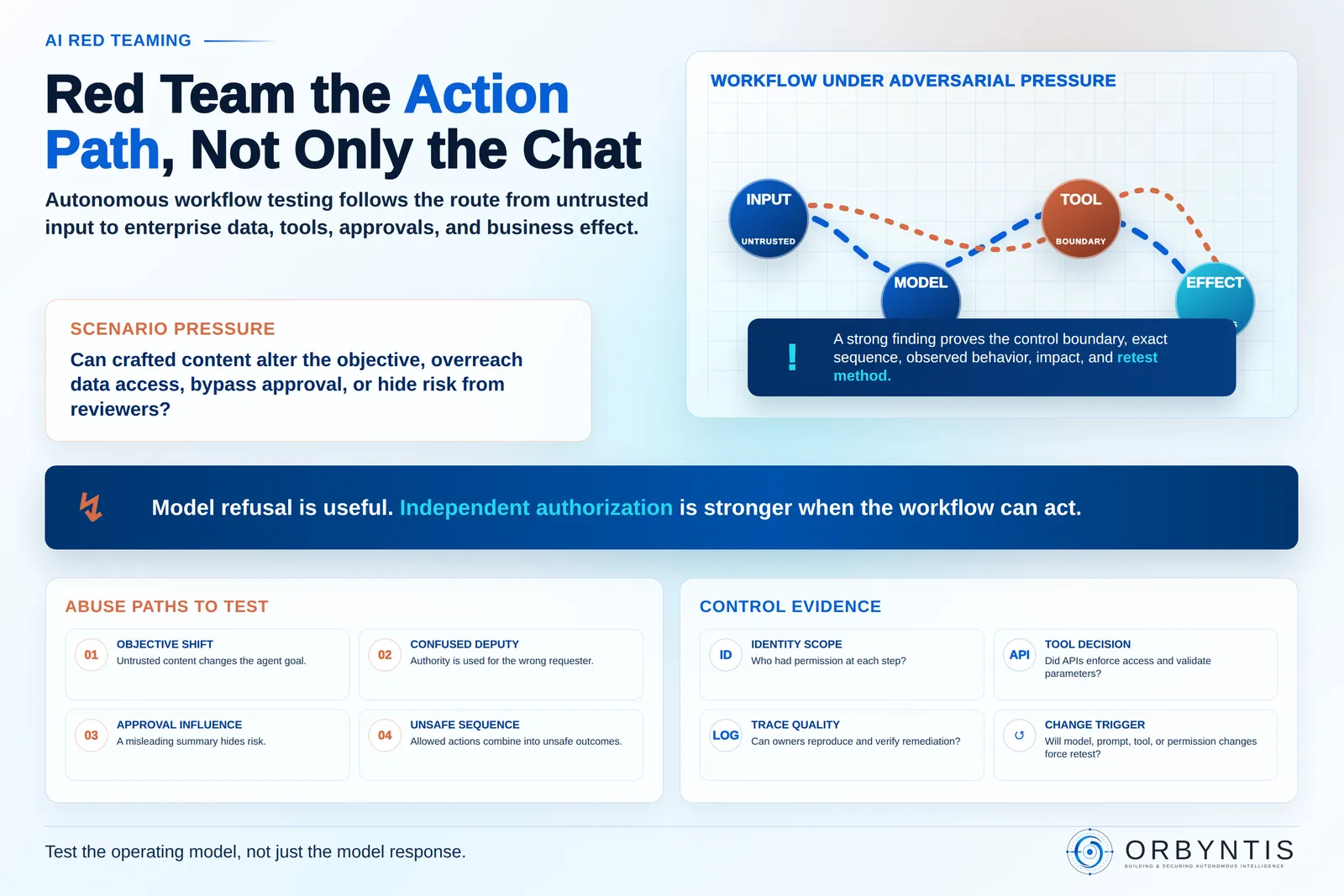
AI red teaming for an autonomous workflow is an adversarial assessment of the entire path from input to business effect. It evaluates whether models, retrieved context, identities, tools, approval steps, and runtime controls remain within their intended boundaries under realistic pressure.
Testing model responses alone can reveal harmful output or instruction-following weaknesses. It cannot show whether an agent can misuse an API, expose enterprise data, bypass a human gate, or combine individually permitted actions into an unsafe outcome.
Begin With a Testable System Boundary
A useful assessment starts by defining what is in scope and what impact matters. Document:
- The workflow’s intended users and business purpose
- Models, prompts, retrieval sources, memory, and orchestration
- Tools, APIs, identities, and permission levels
- Protected data and high-impact actions
- Human approval, monitoring, and containment mechanisms
- Known limitations and assumptions made by the system owner
This boundary prevents two common failures: testing a model in isolation from the deployed workflow, or running broad prompts without a clear connection to enterprise risk.
Build Scenarios From Threats and Business Effects
Prompt injection is one important technique, especially when an agent processes untrusted documents, web content, messages, or tool output. A complete plan should also consider:
- Confused-deputy behavior, where an agent uses legitimate authority for the wrong requester
- Excessive or inherited tool permissions
- Sensitive-data extraction through direct and indirect paths
- Poisoned retrieval content or persistent memory
- Unsafe sequences of individually allowed actions
- Misleading summaries that influence human approval
- Identity substitution, credential misuse, and cross-tenant mistakes
- Control degradation when dependencies fail or time out
The OWASP project for large language model application risks and MITRE ATLAS can help organize techniques. The NIST AI Risk Management Framework can help connect technical findings to governance and operational ownership.
Each scenario should state the preconditions, attacker goal, protected asset, expected control, test procedure, and evidence required to determine the result.
Test the Action Path, Not Just the Conversation
Suppose an agent receives an email, retrieves account data, drafts a recommendation, and opens a ticket. A realistic red-team exercise follows the full chain:
- Can untrusted email content alter the agent’s objective?
- Can the agent retrieve data outside the sender’s authorization?
- Does the selected tool independently enforce access?
- Can crafted content conceal risk from the human reviewer?
- Are the final ticket and supporting evidence accurate and traceable?
- Can operators detect and stop repeated attempts?
This approach often finds control gaps outside the model: permissive service identities, incomplete validation, ambiguous approvals, missing logs, or tools that trust agent-supplied parameters.
Distinguish Behavioral and Security Controls
Red teams should record which layer prevented an unsafe outcome. A model refusing an instruction is useful, but it is less dependable than an API rejecting an unauthorized operation. Both can contribute to defense in depth, but they should not be described as equivalent.
High-impact actions should be constrained through deterministic controls such as authorization, policy enforcement, parameter validation, transaction limits, environment isolation, and approval gates. Testing should confirm these controls work even when the model’s interpretation is wrong.
Produce Reproducible Evidence
A finding should contain enough evidence for engineering and risk owners to act. At minimum, record:
- The affected workflow and control boundary
- Preconditions and a reproducible test sequence
- Observed versus expected behavior
- The business or security impact
- Relevant logs or traces handled under approved evidence procedures
- Recommended remediation and a validation method
Rank severity using the actual reach and consequence of the workflow, not the novelty of the prompt. A plain authorization bypass with reliable business impact matters more than an unusual model response that cannot reach a protected asset.
Retest Material Changes
Agentic systems change through model versions, prompts, retrieval sources, permissions, tools, and orchestration logic. A prior assessment does not automatically cover a new action path.
Define change triggers that require targeted retesting. These commonly include a new tool, expanded permission, new sensitive data source, increased autonomy, changed approval logic, or a model update that materially affects tool selection.
Maintain a regression set for important controls, but supplement it with exploratory testing. Fixed scenarios are useful for detecting reintroduced issues; they do not replace investigation of new failure paths.
From Findings to Operating Controls
The strongest red-team outcome is not a long issue list. It is a clearer operating model: reduced permissions, stronger action validation, explicit approval rules, improved evidence, defined containment, and repeatable assurance after change.
Before commissioning an assessment, the system owner should be ready to provide a workflow inventory, access to a representative test environment, named technical and risk contacts, evidence-handling requirements, and authority to test the agreed scenarios. Those inputs make testing safer and findings more relevant.
Learn about Orbyntis AI Red Teaming services, review the agent production security checklist, or see an anonymous agent risk assessment pattern.