Most AI security conversations still start with the model.
Can the model be jailbroken?
Can it produce harmful output?
Can it be tricked by a malicious prompt?
Those questions matter. But for enterprise AI agents, they are not enough.
The most important question is often quieter:
What can this system actually do after the model responds?
That is where agent risk becomes operational.
An unsafe answer is a content problem. An unsafe action can become a business problem.
The Action Boundary Is Where Risk Changes Shape
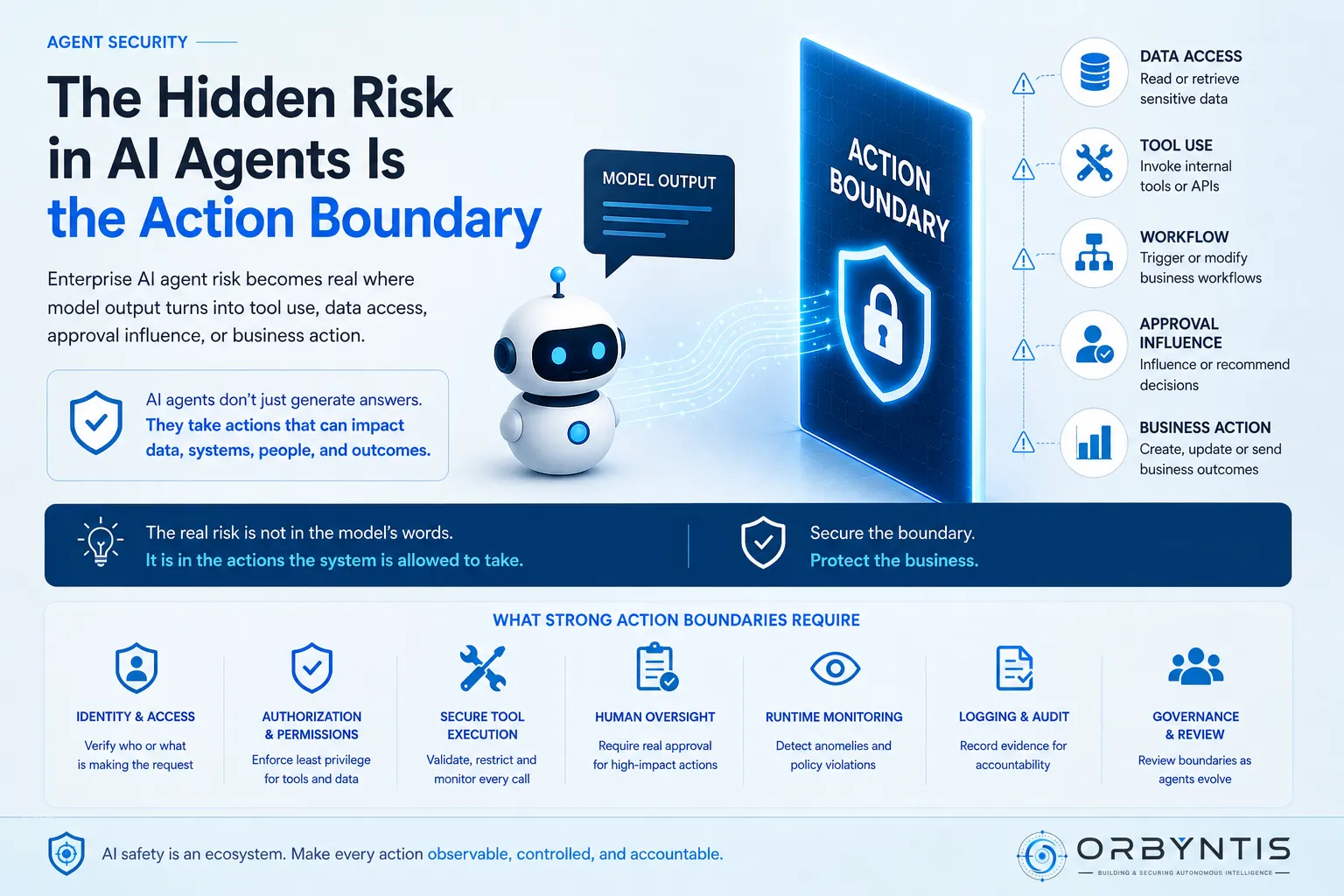
An AI agent becomes materially different from a chatbot when it can cross from language into execution.
That boundary may include:
- Reading private enterprise data
- Calling an internal API
- Opening or closing a ticket
- Updating a customer record
- Triggering a workflow
- Sending a message on behalf of a user
- Recommending an approval decision
- Writing code or configuration
- Coordinating with another agent
At that point, the system is no longer only generating text. It is participating in an operating environment.
The model may still be the most visible part of the system, but the risk lives in the relationship between the model, the tools, the identity, the data, and the business process.
If that relationship is not explicit, the organization may not know where control actually exists.
A Prompt Is Not a Permission Model
Many agent designs rely too heavily on instructions.
The system prompt says the agent should only perform certain actions.
The tool description says when the tool should be used.
The workflow documentation says a human should approve sensitive decisions.
Those are useful behavioral inputs, but they are not the same as enforceable authority boundaries.
If an agent has access to a tool, the enterprise should be able to answer:
- Which identity is used when the tool is called?
- What data can that identity read?
- What records can it modify?
- Which parameters are accepted or rejected?
- Which actions require human approval outside the model?
- What evidence is preserved when the action occurs?
If the answer is “the agent knows what it is supposed to do,” the control is probably too close to the model and too far from the business action.
Tool Access Should Be Treated Like Delegated Authority
When a human employee receives access to a business system, the organization usually thinks in terms of role, responsibility, approval, auditability, and revocation.
AI agents need the same discipline.
A tool is not just a technical integration. It is delegated authority.
An agent with a calendar tool can affect time.
An agent with a CRM tool can affect customer records.
An agent with a code tool can affect software.
An agent with a financial workflow can affect money.
The risk is not only whether the model chooses the right tool. The risk is whether the surrounding system enforces the right boundary when the model chooses incorrectly.
The safer design asks the tool layer to verify the action rather than trusting the model to self-police.
The Boundary Should Follow the Business Impact
Not every agent requires the same level of control.
An internal assistant that summarizes public documentation has a different risk profile from an agent that modifies customer entitlements or recommends a payment exception.
The action boundary should be shaped by business impact:
- What happens if the action is wrong?
- Is the action reversible?
- Does it affect a customer, employee, patient, account, or regulated record?
- Does it create legal, financial, operational, or reputational exposure?
- Can one low-risk action combine with another to create a higher-risk outcome?
- Can the agent reach sensitive data indirectly through a connected tool?
This is why generic AI policy is not enough. The boundary must be designed around the workflow the agent actually touches.
Human Approval Must Be Real Control
Many autonomous workflows include a human step somewhere in the process.
That does not automatically mean the action is controlled.
A human approval step is meaningful only if the reviewer has enough context, enough time, and enough authority to stop the action before it matters.
Approval can fail when:
- The agent summarizes risk in a misleading way
- The reviewer sees only the recommendation, not the source evidence
- The approval happens after the action has effectively been decided
- The reviewer is asked to approve too many low-quality escalations
- The system treats approval as a notification rather than a gate
For high-impact actions, approval should be enforced outside the model. The model may propose. The system should decide whether execution is permitted.
Evidence Is Part of the Control
If an enterprise cannot reconstruct an important agent action, it cannot govern it.
Useful evidence should show:
- The initiating user or event
- The agent identity and version
- The retrieved context or data class involved
- The tool selected
- The parameters passed
- The policy or approval decision
- The resulting business action
- The owner responsible for review or response
This does not mean storing every prompt or every sensitive document forever. Evidence should be deliberate, minimized, and aligned to the importance of the workflow.
But there must be enough record to answer a simple question later:
Why was this action allowed?
Without that answer, trust becomes a feeling rather than an operating control.
Action Boundaries Need Retesting
Agent systems change constantly.
Models are upgraded.
Prompts are rewritten.
Tools are added.
Permissions expand.
Retrieval sources change.
Business processes evolve.
An action boundary that made sense during a pilot may not be sufficient after the agent gains a new tool, reaches a new data source, or starts serving a different business unit.
Retesting should be triggered by material changes, especially:
- New tools or APIs
- Expanded permissions
- New sensitive data sources
- Changed approval logic
- New memory behavior
- Increased autonomy
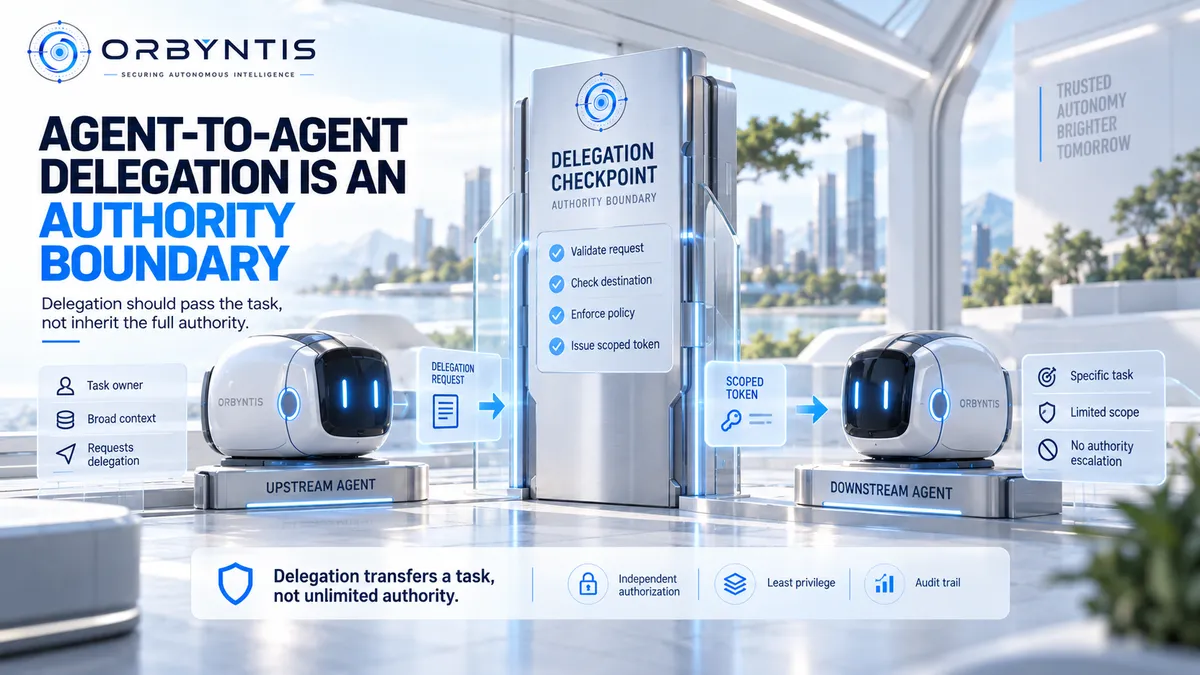
- New agent-to-agent delegation
- Model or orchestration changes that affect tool selection
The question is not whether the agent passed a test once.
The question is whether the boundary still holds after the system changes.
What Leaders Should Ask Before Production
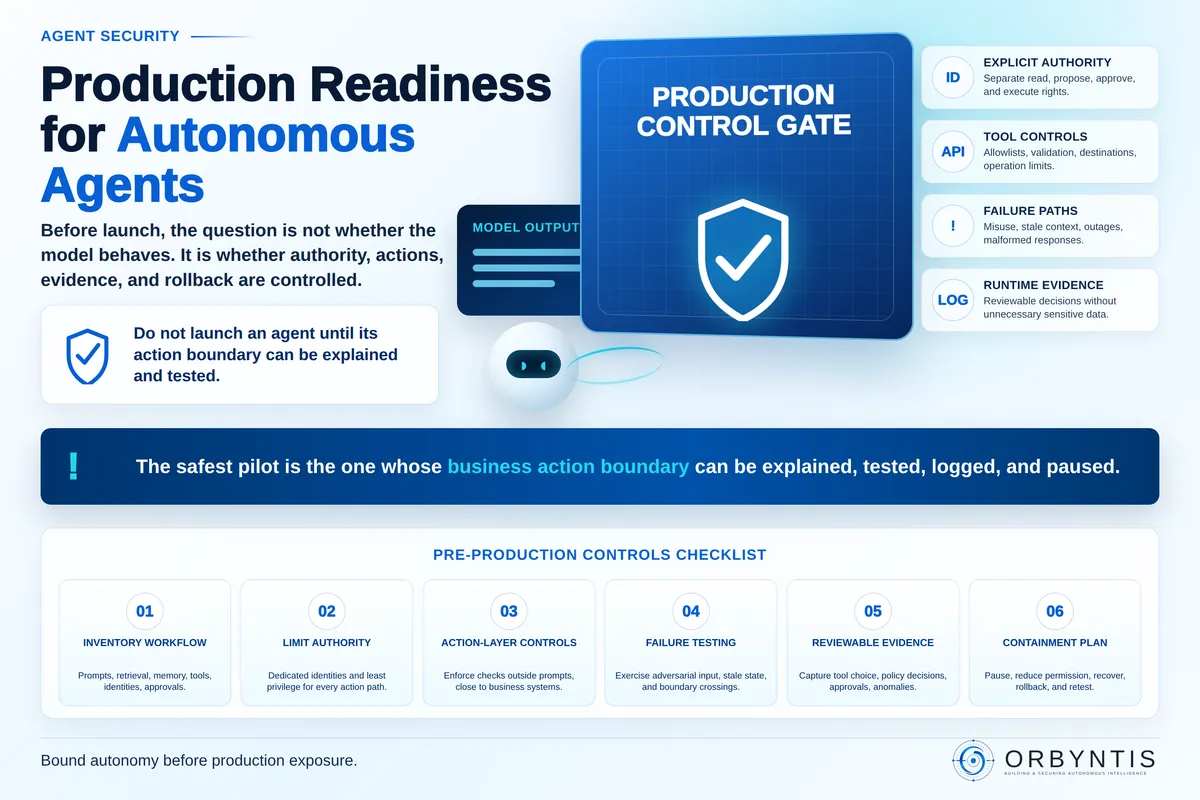
Before an AI agent reaches a business-critical workflow, leaders should ask:
- What actions can this agent initiate?
- Which actions are read-only, reversible, high-impact, or irreversible?
- Which system enforces permission: the model, the app, the API, or a policy layer?
- What requires human approval, and where is that approval enforced?
- What evidence is captured when the agent acts?
- Who can pause, restrict, or retire the agent?
- What change would require the boundary to be reviewed again?
These questions are not meant to slow innovation. They are meant to make autonomy usable.
The enterprise goal is not to remove every risk from AI.
It is to make sure the system’s authority is visible, its controls are testable, and its important actions are reviewable.
That is the real boundary between an impressive demo and an AI agent that can be trusted in production.
Explore Orbyntis Agent Security & Runtime Risk Assessment, read the AI agent production checklist, or review why guardrails are not the whole AI security architecture.