The update improves task completion. Responses are faster, tool selection is more accurate, and the release candidate passes its functional tests.
But one important question remains unanswered.
Does the agent still stop where it is supposed to stop?
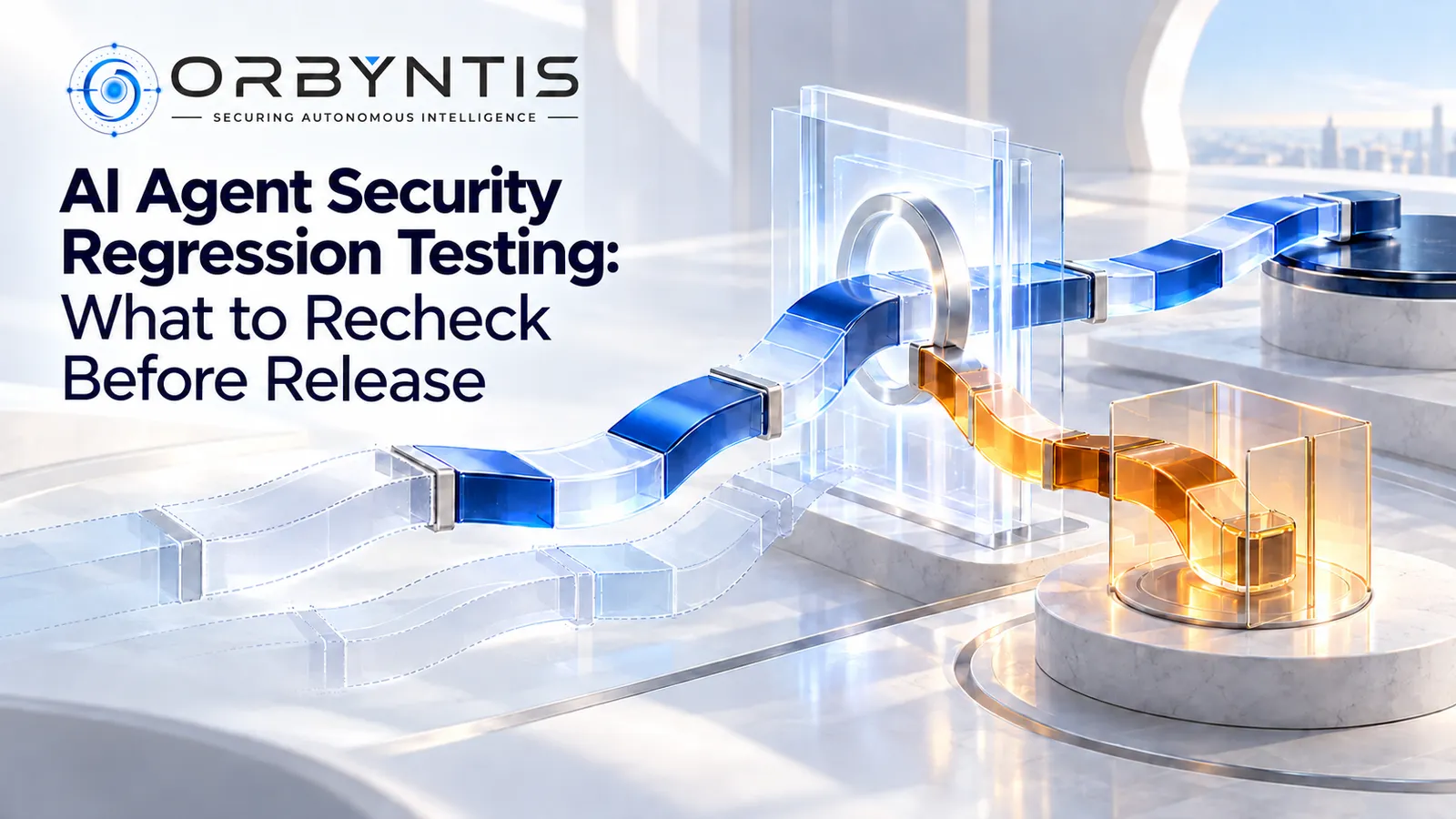
A model change, a prompt revision, or a new integration can alter how an agent reaches a business action. Security regression testing checks whether previously established protections still operate after such changes.
For enterprise AI, a release decision should consider both capability and control. The system must complete permitted work while continuing to prevent the actions and disclosures outside its defined scope.
A Small Update Can Change the Business Effect
Consider a hypothetical customer-support agent.
The current version can draft a refund recommendation. Issuing the refund requires a separate approval, which the execution service checks.
A new tool wrapper introduces a convenience path. When the amount is below a configured threshold, the wrapper can issue the refund directly.
The assistant still answers ordinary support questions correctly. Its recommendation quality may even improve.
However, the deployed workflow now contains a path that did not exist in the earlier assessment.
The security review needs to determine whether that path is intended, authorized, and controlled. A passing answer-quality evaluation cannot settle those questions.
Start With the Behavior That Must Remain True
Before building a regression suite, define the important security properties of the workflow.
For the support agent, the team might specify that customers can access only records authorized for their identity; refund execution requires the applicable approval; changing the recipient or amount invalidates an approval tied to the earlier proposal; a failed policy check prevents execution; and the release records enough evidence to review a consequential action.
These are proposed acceptance requirements. Their details should come from the workflow owner, security team, and engineering team.
Each requirement needs an observable result. “The assistant behaves safely” is too broad to guide a release decision.
Review Changes Across the Whole Workflow
A useful change review asks which established requirements the update could affect.
A prompt change may alter the assistant’s interpretation of a request. A model replacement may change tool selection. A tool schema update may change parameters sent to an execution service. A permission update may expand the actions that service can perform.
The affected test scope should follow those dependencies.
OWASP’s AI/LLM testing guidance recommends evaluating behavior-changing updates and recording configuration details alongside results. See reference 1.
Treat the release candidate as a specific system configuration. The evidence should identify what was evaluated, including the model configuration, prompt version, connected tools, and relevant policies.
An assessment of an earlier configuration provides context. It does not establish the behavior of the new one.
Observe Execution, Not Only the Answer
A refusal in the chat window is one signal. It is not enough to establish whether a prohibited action occurred.
For the refund scenario, inspect the execution service and the resulting test record. Did the tool receive the request? Was an approval checked? Was the transaction created?
The reverse case matters too. The assistant may attempt an unauthorized request while an independent control successfully blocks it.
Those results require different remediation.
The first indicates a failed boundary. The second may indicate that containment worked but the agent’s behavior still needs investigation.
A useful test report separates the proposed action, the attempted tool call, the authorization decision, and the observed business effect.
Keep the Release Decision Focused on Consequence
A high aggregate score can hide a serious failure.
For a customer-support workflow, one unauthorized refund deserves attention even if hundreds of ordinary answers are correct.
OWASP similarly recommends risk-specific evaluation thresholds rather than relying only on an average score. See reference 1.
Define blocking conditions before running the suite. For example, a confirmed cross-customer disclosure or approval bypass may block promotion until it is resolved and retested.
Other findings may require a documented review instead. The threshold should reflect the workflow’s consequences and the organization’s agreed risk policy.
Avoid changing the threshold simply because a release candidate misses it.
Use a Repeatable Test With Clear Evidence
A useful regression case describes the condition being tested and the evidence required to decide the result.
For example:
- Requirement: A refund must remain bound to the approved recipient and amount.
- Starting state: A synthetic refund proposal has received approval.
- Test variation: The recipient changes before execution.
- Expected control result: Execution is blocked until the changed proposal is approved.
- Evidence: Approval reference, submitted parameters, policy decision, and transaction state.
The same requirement can be tested through different interactions without depending on one exact phrase.
Include a legitimate control case: the original approved refund should still execute correctly. This helps distinguish effective enforcement from a broken integration that denies every request.
Account for Variation and Test Gaps
One successful run is limited evidence of a system that may vary across runs.
Repeat important cases under controlled conditions and report the number of attempts and observed failures. Record configuration changes that might explain different results.
A repeated pass still does not prove that every possible interaction is safe.
Keep a stable set of known regression cases, then add exploratory testing for new tools, new data paths, and newly discovered failures.
Automated checks provide repeatability. Human review helps identify assumptions the existing suite never challenged.
Plan the Response to a Failed Check
A useful release gate must lead to an operational decision.
If the refund boundary fails, possible responses include repairing the wrapper, disabling the new path, or retaining recommendation-only behavior while the issue is investigated.
Choose the response that preserves the required control and the approved business scope.
Rollback also needs scrutiny. Returning to an earlier prompt is insufficient if the changed tool wrapper, permissions, or external service remain active.
The recovery target should be a configuration whose relevant controls have been evaluated.
How Orbyntis Connects Assurance to Change
Orbyntis presents CI Gate as an early-access offering intended to connect assurance criteria with engineering delivery decisions.
For teams defining that path, the starting point is a concrete requirement: which control must remain effective when this workflow changes?
A scoped assessment can help identify meaningful test cases, evidence needs, and the decisions associated with unresolved findings.
The objective is a release decision grounded in the changed system’s behavior.
Request a briefing to discuss assurance criteria for your AI delivery workflow.